
Virtual Net Billing in Cyprus: Solar Without a Roof
How virtual net billing in Cyprus works: panels on one site credit the EAC bill of another. Who it suits, the 400 kWp limit, real returns and the process.
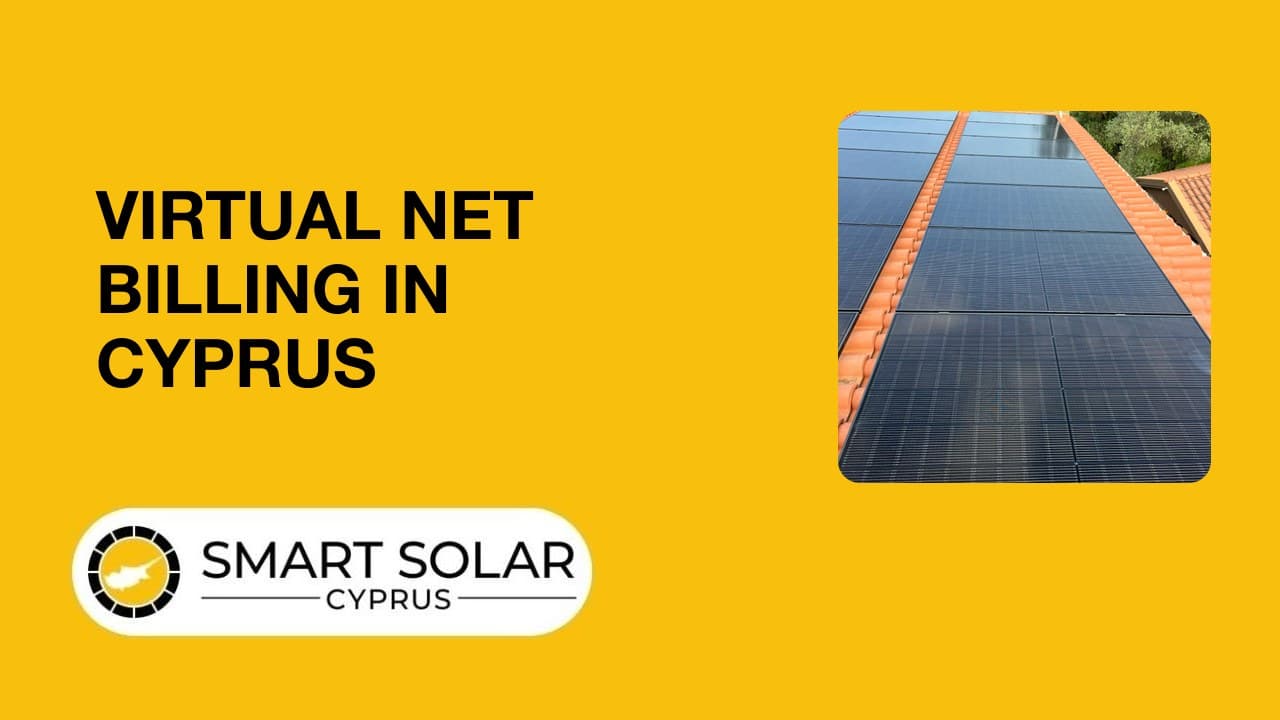
Every week we speak to people who want solar and have nowhere to put it. They live in a flat in Limassol with no rights to the roof, or in an old-town house in Nicosia where the roof is small and shaded, or they run a shop whose landlord will not allow panels. Many of them own a plot of land in the family village, or a second building with a perfectly good south-facing roof.
Virtual net billing is the scheme built for that situation. The panels go where the sun is, and the electricity they export is credited against the EAC bill of a property somewhere else. It is useful, but the numbers work very differently from a normal rooftop system, and it pays to understand why before you sign anything.
This guide explains how virtual net billing works in Cyprus, who it suits, what it is worth in euros, and how the application process runs.
What virtual net billing is
Under ordinary Net Billing, your panels sit on the building that uses the power. The house consumes what it can in daylight and exports the rest. Your EAC bill charges you for imported energy and credits you for exported energy.
Virtual net billing separates the two locations. The photovoltaic system is installed at one site and connected to the grid there. It has no load of its own, so it exports everything it produces. That exported energy is then credited, in euros, against the consumption bill of a different premises: your home, your flat or your business.
Two meters do the work. One records the production of the virtual system. The consuming premises keeps its own bidirectional meter recording imports (and exports, if it has any). The supplier offsets the two on each bill, monthly or every two months depending on your tariff category, across a 12-month period, the same way as standard Net Billing.
The arrangement is formalised in a virtual net billing contract with your supplier, which runs for 10 years and can be renewed under whatever framework is in force at that point.
Virtual net billing vs virtual net metering
The two names get mixed up constantly, and the difference matters.
- Virtual net metering: the older scheme for households (up to 10.4 kWp) and professional farmers and wineries (up to 100 kWp). Credits were counted in kilowatt-hours, so an exported kWh offset an imported kWh almost one for one. EAC now offers this contract only to customers who applied to the distribution system operator by 31 December 2025. It is closed to new systems.
- Virtual net billing: the scheme still listed by the EAC for new systems. Credits are counted in euros, and exported energy is valued at the much lower Net Billing export rate.
If you read an older article promising that a virtual system will "zero your bill", it was almost certainly written about virtual net metering. The economics below are for virtual net billing, which is what a new application gets today.
Who it suits
Virtual net billing makes sense when a rooftop system on the building you use is impossible or poor value. The cases we see most:
- Apartment owners: you own your flat but not the roof, or the roof is already full of water heaters and AC units. A system on a family plot or another property can still credit your flat's bill.
- Shaded or tiny roofs: old village houses, homes surrounded by taller buildings, and roofs with heavy shading from trees or neighbouring blocks.
- Listed or restricted buildings: properties where panels on the roof are not permitted or would need approvals you are unlikely to get.
- Businesses with land: hotels, factories and farms with spare ground away from the main building. The 2024 amendment to the self-consumption plan was written partly with hoteliers in mind, allowing a business to combine a local system with one or more virtual systems against the same consumption bill.
- Multiple properties: owners with a good roof on one building and a large bill on another.
If your own roof is usable, even partly, a normal rooftop system is almost always the better first step. We explain why in the next section.
What it is actually worth
This is the part most sales pitches skip. Because a virtual system has no load at its site, none of its output is self-consumed. Every kWh is exported, and under Net Billing exported energy is credited at a rate set under the CERA framework, recently around €0.09 to €0.11 per kWh. The electricity it offsets at your home costs roughly €0.29 to €0.32 per kWh all-in.
On a rooftop system, the power you use as it is produced saves you that full retail price. On a virtual system, every unit is worth the export rate. A virtual kWh is worth roughly a third of a self-consumed one.
A worked example
Take a 5 kW system on a family plot near Paphos, with a clear south-facing aspect. In Cyprus that produces around 8,500 kWh a year (our guide to how much electricity solar panels produce in Cyprus shows where that figure comes from).
- Annual export credit: 8,500 kWh at €0.09 to €0.11 is roughly €765 to €935 a year.
- The same 5 kW on your own roof: if half the output were used in the house at around €0.30 and half exported at €0.10, it would be worth roughly €1,700 a year.
- Installed cost: a 5 kW rooftop system typically costs €6,500 to €7,500. A ground-mounted virtual system usually costs more once you add the mounting structure, any trenching, permits and the connection conditions issued by the distribution system operator.
On those numbers a virtual system pays back in something like 8 to 11 years, against a few years for a well-used rooftop system. Over a 25-year panel life it still comes out well ahead, but it is a slower investment. Treat the figures as illustrative: your export rate, site and connection costs will move them. Our cost guide has current pricing for standard systems.
Sizing a virtual system
Because the credit is a euro amount set against your import charges, there is a ceiling on what it can usefully offset. Under Net Billing any credit left after the annual clearing is wiped, so oversizing simply hands surplus energy to the grid for nothing.
In practice, households rarely hit that ceiling. A family importing 6,000 kWh a year pays around €1,800 for it, and offsetting that fully at €0.10 per exported kWh would take about 18,000 kWh, more than a 10 kW system produces. For most homes the limit on size is budget and payback, not the clearing rule. For businesses with large bills, it is worth modelling properly; the solar calculator gives a first estimate.
Limits and rules
The headline rules as published by the EAC and the Energy Service:
- Size: up to 400 kWp per consumption account and per beneficiary, or up to 1 MW per consumption account where the system includes energy storage.
- Who can apply: individuals, companies, and public and local authorities, for systems connected to the distribution network that serve their own consumption.
- Where the panels can go: on the roof of a legally built building; on the ground within a plot that has a legally existing building (a building permit is needed if the panels cover more than 20 m²); or on the ground of a plot with no building, where installation is allowed and the necessary planning and building permits are obtained.
- Licensing: systems above 50 kWp need a general licence from CERA before the EAC application.
- Contract: 10 years, renewable under the framework in force at the time.
Scheme details have changed several times since 2022, and a few points, such as whether a household can run a virtual system alongside a rooftop system on the same account, depend on the current version of the plan. We check these against the live EAC and Energy Service guidance for every application.
The application process
The steps follow the standard grid connection route, with an extra stage for the land or building where the panels will sit.
- Site check: confirm the site gets full sun, that the land use allows solar, and who owns it. If the plot belongs to a relative, get their written consent early.
- Permits: apply to the district authority for a building permit or an exemption certificate, as required for the site.
- EAC application: apply to the EAC as distribution system operator, with a CERA licence first for anything above 50 kWp.
- Connection conditions: the EAC issues the terms and cost of connecting the site, which you pay before work starts.
- Installation: panels, inverter and mounting go in, followed by an EAC inspection and certificate of conformity.
- Contract: you sign the virtual net billing contract with your supplier and the credits start appearing on your consumption bill.
The connection stage is usually the slowest, as with any solar installation in Cyprus, and rural sites far from existing grid capacity can take longer.
Alternatives worth comparing
Before committing to a virtual system, compare it with these options:
- A smaller rooftop system: even 2 to 3 kW on a part-shaded roof can beat a larger virtual system, because more of its output is used at full value.
- Rooftop panels plus a battery: a battery storage system moves daytime surplus into the evening, which is where the Net Billing gap between import and export prices hurts most.
- Shared roof on an apartment block: some blocks agree to install panels on the common roof. It needs agreement from the management committee and careful metering, but self-consumption is possible.
We are happy to price more than one route so you can compare them side by side.
Frequently Asked Questions
Can I use virtual net billing if I live in an apartment?
Yes, that is one of the main uses. The panels need a suitable site elsewhere, such as a plot of land or another building, and the export credit is applied to your flat's EAC consumption bill.
Is virtual net metering still available in Cyprus?
Not for new systems. The EAC offers virtual net metering contracts only to customers who applied to connect by 31 December 2025. New virtual systems go onto virtual net billing.
How much will virtual net billing save on my bill?
Each exported kWh is credited at the Net Billing export rate, recently about €0.09 to €0.11. A 5 kW virtual system producing around 8,500 kWh a year would be worth roughly €765 to €935 a year in bill credits.
Does the land have to be in my name?
You need the legal right to install on the site, and the owner's consent if it is not yours. Ownership and planning rules vary by plot, so we confirm this before any application is submitted.
Can I add a battery to a virtual system?
Yes. The size limit rises to 1 MW per consumption account with storage, although for a household a battery adds more value at the home itself, where it can cover evening use.
If you have a plot or a second building and want to know whether virtual net billing makes sense for you, request a quote and we will model the site, the connection and the return against a rooftop alternative.
Want a quote tailored to your roof and your bill?
A free site visit and proposal, with no obligation and no pressure.
Keep reading
All articles
How to Read Your EAC Bill With Solar Panels in Cyprus
Your EAC bill with solar panels, line by line: import and export readings, net metering credits, Net Billing euro credits, and why the bill can still rise.

Heat Pump With Solar Panels in Cyprus: 2026 Guide
Running a heat pump on solar in Cyprus: running costs, how much PV it needs in winter, what installation costs and how Net Billing changes the sums.
Solar Water Heating in Cyprus: Thermal vs PV in 2026
Your solar water heater's electric element versus heating water with surplus photovoltaic power. What each costs in Cyprus and which wins in 2026.