
Consumption-based sizing
We analyse 12 months of your EAC bills and model your evening usage, so the battery is sized to your life, not a one-size box.
Under Net Billing, exported solar earns wholesale rates while evening imports cost full retail. A correctly sized battery captures that gap, storing your surplus at midday and spending it after dark.
Trusted partners: only top-tier components







The Net Billing business case
Since January 2026, every new PV system in Cyprus connects under Net Billing: surplus you export is credited at roughly €0.08–0.11 per kWh, while the power you import in the evening costs around €0.25. That spread is where a battery earns its keep. Every kilowatt-hour you store at midday and use after dark is worth the full retail rate you avoid paying EAC, not the wholesale rate you'd have earned exporting it.
The effect on a real bill is substantial. A 5kW array generates 25–30 kWh on a sunny Cyprus day while the house behind it consumes 15–20 kWh in total, much of it after sunset. Without storage, the surplus is sold to the grid for cents and bought back at premium evening rates. Pair the same panels with a correctly sized battery and the combination typically covers 85–95% of a household's annual electricity needs.
Battery pricing in Cyprus currently runs €800–1,000 per kWh of storage installed. A typical 10kWh home system totals €8,000–10,000, a compact 5kWh setup proportionally less, and in most homes self-consumption savings return the investment in 6–8 years before any subsidy is counted. The table below shows what that looks like across common household sizes.
State support is moving the same way, just slower than the headlines suggest. The €1,500 residential PV grant closed at the end of 2025, and a dedicated home-battery subsidy has been announced, though as of mid-2026 applications haven't opened. Meanwhile the Save and Upgrade Homes 2026 grant, expected to open in September, lists battery storage among its eligible measures for older homes doing a wider energy upgrade. We track both and prepare your paperwork the moment a window opens.
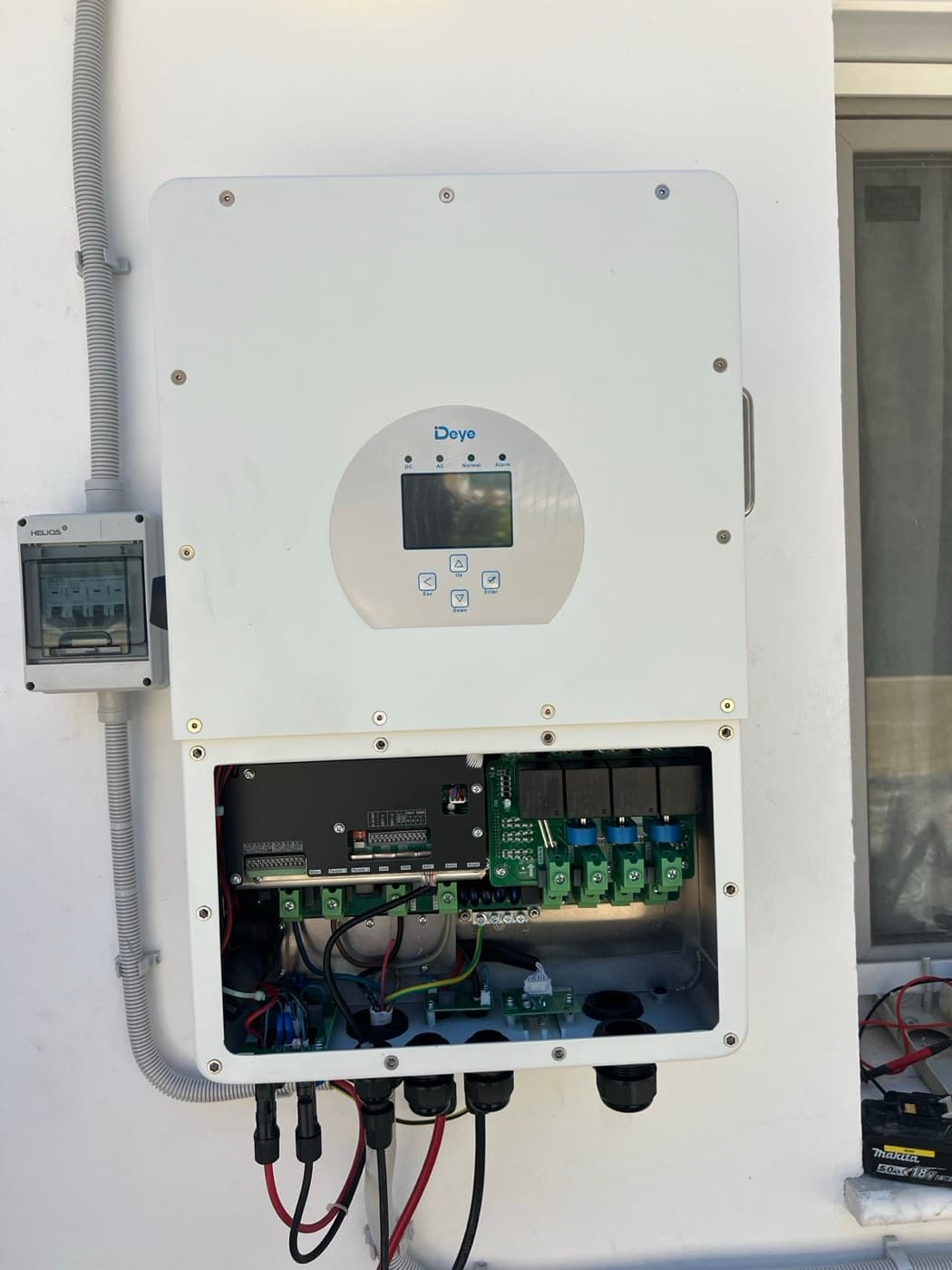
On the hardware side, we install lithium systems, mostly LFP, rated for 6,000+ charge cycles: 15–20 years of daily use in practice. Modern units weigh 100–125kg, mount cleanly on a wall, and run silently, so a garage or shaded utility room is all the space they need. Cyprus's mild climate helps here, since the cells perform best between 15 and 35°C, which a shaded indoor spot provides most of the year.
You don't need a brand-new solar system to add storage, either. Hybrid-inverter systems accept a battery directly, while older string inverters take an AC-coupled retrofit battery or an inverter upgrade. We assess which route makes financial sense for your setup, and if the honest answer is 'not yet', that's what we'll tell you.
Prices & sizing
Installed prices from our current projects, at €800–1,000 per kWh of storage depending on brand and configuration. Every figure is confirmed with a free sizing assessment of your actual EAC bills.
| Battery size | Typical home | Installed price | What it covers |
|---|---|---|---|
| 5 kWh | Apartment or small home with low evening use | €4,000–5,000 | Lighting, fridge, TV and devices through the evening |
| 10 kWh | 3-bedroom home without a pool | €8,000–10,000 | Full evening and overnight use; saves around €1,800 a year |
| 14–20 kWh | Larger home with a pool or several ACs | €11,200–20,000 | Pool pump, air conditioning and overnight autonomy; €3,000–4,000 a year |
| 30 kWh+ | Commercial premises | Custom quote | Modular banks sized to your operating hours, expandable as you grow |
Sizing follows your evening consumption, not your total daily usage. We model both from 12 months of EAC bills before quoting, so you're not paying for capacity you won't use.
Packages & prices
Home Solar Battery Storage: 5 to 20 kWh
See the four installed packages, what each one covers, the specs and the warranty on the product page.
What you get
We analyse 12 months of your EAC bills and model your evening usage, so the battery is sized to your life, not a one-size box.
LFP and lithium-ion systems rated for 6,000+ cycles, from manufacturers with authorised support in Cyprus. We handle servicing and warranty claims ourselves.
New installs get a hybrid inverter from day one; existing systems are assessed honestly for an AC-coupled retrofit or an inverter upgrade.
Keep essential circuits (fridge, lights, internet) running through power cuts with automatic switchover. Grid-tied panels alone can't do this.
CERA-certified installation with EAC applications, technical drawings, EN 62619 compliance, anti-islanding protection, and any storage subsidy you qualify for, prepared and filed by us.
Smart controllers prioritise solar, then battery, then grid, automatically maximising the value of every kWh you generate.
How it works
We review your bills and usage patterns to size the battery precisely: no oversizing, no undersizing.
An itemised quote with expected self-consumption gains and honest payback maths under the current Net Billing rules.
Mounting in the morning, inverter and panel integration in the afternoon, commissioning before we leave. Coastal homes within 500m of the sea get marine-grade enclosures at no extra charge.
We configure charge priorities, test backup switchover, and set up your monitoring app so you can watch the battery work from your phone.
FAQ
More questions? Our team is reachable on WhatsApp, by phone, or through our contact form.
Book a free assessment and we'll size a battery to your real consumption, with honest payback maths from your actual EAC bills.