
Solar Water Heating in Cyprus: Thermal vs PV in 2026
Your solar water heater's electric element versus heating water with surplus photovoltaic power. What each costs in Cyprus and which wins in 2026.
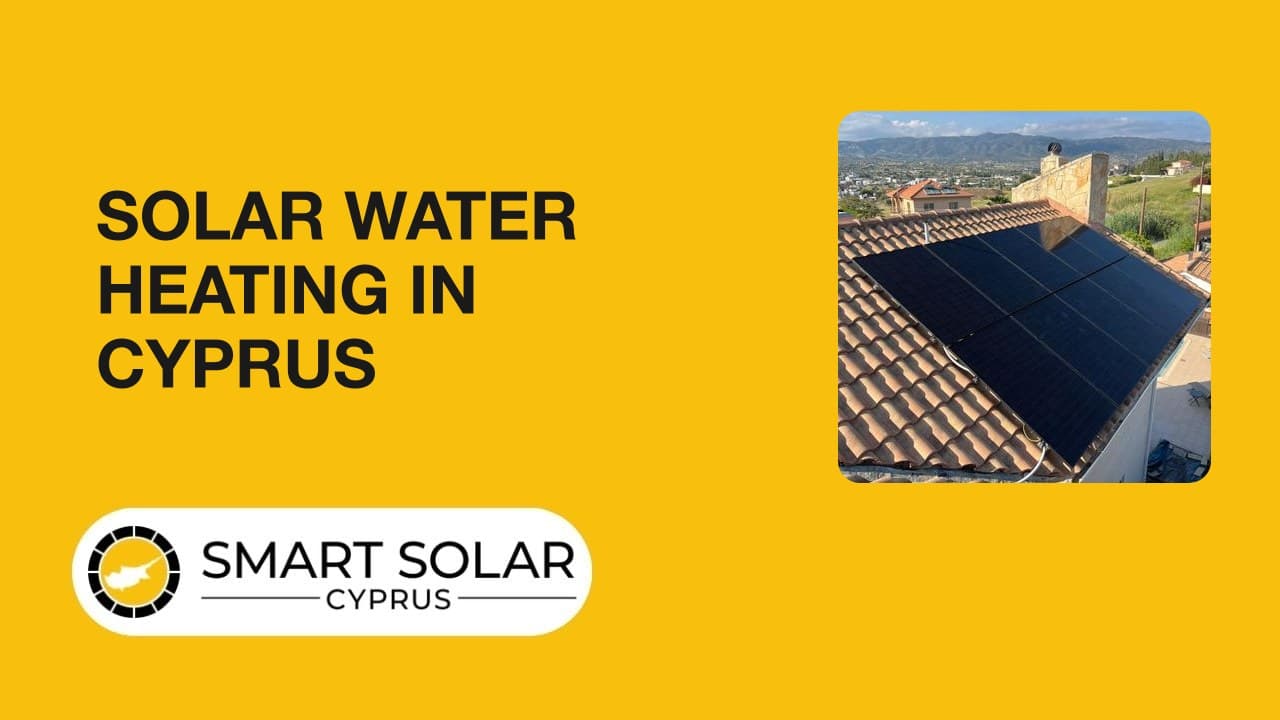
Almost every house in Cyprus already heats water with the sun. The cylinder and the two glass collectors on the roof are so ordinary here that most people stop seeing them. Cyprus has the highest share of households with solar water heating anywhere in the EU.
So when a homeowner asks us about solar water heating, the real question is narrower than it sounds. It is not whether to heat water with the sun. It is what to do about the electric element inside that cylinder, the one that quietly switches on through winter and on cloudy weeks, and whether a photovoltaic system should be taking that job over.
Since January 2026 that question has a different answer than it did two years ago.
What the thermosiphon on your roof actually does
The standard Cyprus system is a thermosiphon: two flat-plate collectors feeding a horizontal cylinder mounted just above them, with no pump and no controller. Water warms in the collectors, rises by convection into the tank, and colder water sinks to take its place. There is almost nothing to go wrong, which is why these units last as long as they do.
From roughly April to October it does the whole job. A 150-litre cylinder with two collectors will sit at 60 to 70 degrees by mid-afternoon through a Cyprus summer without any electricity at all. That is genuinely free hot water for more than half the year.
The gap is the other half. Between late November and March, short days, lower sun angles and a run of cloudy mornings mean the tank often comes up to 30 or 35 degrees and no further. That is when the backup element, the ηλεκτρική αντίσταση, does the rest. Most Cyprus cylinders have a 3 kW or 4 kW element, and on a switch that people leave on.
What that electric element costs you
This is the part that surprises homeowners. A 3 kW element heating a 150-litre tank from 30 degrees up to 60 degrees uses roughly 5 to 6 kWh. Do that on most days from December through February and you are looking at somewhere around 400 to 550 kWh over the winter, plus whatever gets used on cloudy spells in the shoulder months.
At the all-in Cyprus rate of roughly €0.29 to €0.32 per kWh, that is about €120 to €180 a year for a family home, and more if the element is on a timer that fires every morning regardless of how warm the tank already is. Our breakdown of electricity prices in Cyprus explains why the all-in figure lands so far above the EAC energy charge people usually quote.
A few things push that number higher than it needs to be:
- An element left switched on permanently. It reheats the tank overnight even when the sun would have done it for free by 11:00 the next morning.
- Timers set for the early morning. Heating at 06:00 is the worst time: it is the coldest part of the day, the tank has been losing heat all night, and there is no solar contribution to build on.
- A tired cylinder. Insulation degrades, and a 20-year-old tank loses heat overnight that a new one keeps.
Heating water with your photovoltaic system instead
Under Net Billing, every kilowatt-hour you export earns roughly €0.08 to €0.10, while every one you import costs €0.29 to €0.32. A unit you consume yourself is worth about three times one you sell. That single ratio is what changed the answer here.
Water heating happens to be the easiest load to move into the generating window, because hot water stores. A tank is a battery that holds heat instead of electricity, and you already own one. If your array is exporting surplus at midday and your element runs at 06:00 on grid power, you are selling energy at €0.09 and buying it back at €0.30 a few hours later.
There are two practical ways to stop doing that.
A timer moved into the middle of the day
The cheapest fix in this entire article costs nothing. Move the element's timer to run between roughly 12:00 and 15:00 instead of overnight or early morning. On a winter day the collectors have already lifted the tank as far as they are going to, the array is at its best output, and the element tops up the last 20 degrees on solar rather than grid power.
On a house with a 5 kW array that alone typically converts most of the winter water heating into self-consumption, using only the timer you already have.
A solar diverter
A diverter watches your export at the meter and, instead of letting surplus go to the grid, sends it to the immersion element in a modulated way. If you are exporting 800 W it feeds 800 W into the element, and if you start the kettle it backs off instantly.
- Cost: typically €400 to €700 fitted, depending on the unit and how the cylinder is wired.
- What it saves: for a household that uses the element year-round, commonly 400 to 700 kWh of imports a year, so roughly €120 to €220.
- Payback: usually in the region of three to five years, which is comparable to the rest of the system.
- Where it does not pay: if your thermosiphon already carries you through most of the year and the element rarely runs, a timer change captures most of the benefit for free.
A diverter only makes sense once the array is large enough to have genuine midday surplus. If the house already consumes everything it generates, there is nothing to divert.
Should you replace the thermosiphon with a heat pump?
A heat pump cylinder moves heat from the air into the water rather than making heat directly, so it delivers roughly three to four units of heat per unit of electricity. Heating the tank that costs 5.5 kWh on an element costs around 1.5 kWh on a heat pump.
In Cyprus the case is more nuanced than in northern Europe, because the thing a heat pump replaces is mostly already free:
- Installed cost runs roughly €1,800 to €3,000 for a domestic unit, well above a replacement thermosiphon.
- It competes with free heat. Eight months a year your collectors already reach temperature with no input. A heat pump saves you nothing in July.
- It pairs well with PV. A 1 kW draw for two or three hours in the middle of the day suits a solar array.
- It earns its keep in winter, exactly where the thermosiphon falls short, and on a third of the electricity the element would use.
- It takes up space and makes noise. These units need airflow and sit near the house, not on the roof where the cylinder was.
Our view for most Cyprus homes: keep the thermosiphon, since it is doing the heavy lifting for free, and solve the winter gap with a timer or a diverter first. A heat pump cylinder is worth considering when the existing tank is at the end of its life anyway, when demand is high year-round, or on a new build where there is no thermosiphon yet.
Where a battery fits in
A hot water cylinder stores heat cheaply and loses it overnight. A battery stores electricity, keeps it for days, and can run anything in the house, not just the element. If you have surplus at midday and one place to put it, the cylinder is the cheaper store. If you want that surplus available for the evening air conditioning, the fridge and the lights as well, that is battery storage territory.
In practice a house with a well-sized array, a battery and a midday element timer covers hot water almost incidentally, and whatever is left over charges the battery for the evening. Our engineer's guide to whether you need a battery works through when that investment stacks up under Net Billing.
Sizing an array that covers hot water too
Hot water is a modest load next to cooling, but it is worth accounting for when you size the system rather than bolting it on afterwards.
- Element top-ups only, winter: roughly 5 to 6 kWh on a day you need it. An array of 4 kW upwards will usually have that available even in December.
- Heat pump cylinder, year-round: roughly 1.5 to 2 kWh a day, drawing around 1 kW while it runs. Easily covered by a typical residential array.
- Full electric water heating with no solar thermal: roughly 1,800 to 2,200 kWh a year for a family, which argues for 6 kW or more.
Winter is the binding constraint, because a Cyprus array produces roughly a third as much in December as in June, and December is when the element runs. Our guide to what size solar system you need in Cyprus starts from twelve months of EAC bills, and the solar savings calculator gives an indicative size and payback before you speak to anyone.
A sensible order of work
For a typical Cyprus home with an existing thermosiphon:
- Check the element is not running unnecessarily. Switch it off for a week in spring and see whether anyone notices. Many households find they do not.
- Move the timer to midday. Free, and it converts most winter heating to solar if you have an array.
- Service or replace a tired cylinder. New insulation and a working thermostat cut standing losses before you spend on anything clever.
- Add a diverter if the element still runs often and you have real midday export.
- Consider a heat pump cylinder when the tank needs replacing anyway, or on a new build.
Most of that costs little or nothing, and the photovoltaic array is what makes steps two and four work. A full photovoltaic system survey looks at hot water alongside cooling and cooking, then sizes for the total. You can request a quote and we will work through the numbers on your actual bills.
Frequently Asked Questions
Is solar water heating worth it in Cyprus?
Yes, and it already pays for itself in most Cyprus homes. A thermosiphon provides hot water with no electricity for roughly eight months of the year, and a replacement system typically pays back within four to six years. The question worth asking is how to cover the winter months without importing grid electricity at €0.30 per kWh.
How much does a solar water heating system cost in Cyprus?
A standard domestic thermosiphon with a 150 to 200 litre cylinder and two collectors typically runs €900 to €1,600 supplied and installed. A heat pump water heater is considerably more, roughly €1,800 to €3,000. Grant schemes for replacing residential solar water heating systems have run through the Cyprus RES and Energy Saving Fund in past rounds, so check what is currently open before you buy: our summary of solar panel grants in Cyprus tracks the schemes we see move.
What is the lifespan of a solar hot water system?
The collectors usually outlast the cylinder. Flat-plate collectors commonly run 20 to 25 years in Cyprus conditions, while cylinders give 12 to 18 years before corrosion or insulation losses make replacement worthwhile. Check the sacrificial anode inside the tank every few years: replacing it is far cheaper than replacing the cylinder.
Which is better, a solar water heater or a heat pump?
For an existing Cyprus house with a working thermosiphon, the thermosiphon wins because its summer output is free and a heat pump cannot beat free. A heat pump is the stronger choice when you are starting from nothing, when the old cylinder needs replacing anyway, or where demand is high all year. Pairing one with a photovoltaic array is what makes it cheap to run.
How many solar panels do I need to run a water heater?
To cover a 3 kW immersion element while it runs you need roughly 4 kWp of array, eight to nine 450 W panels, though in practice the element only tops the tank up rather than heating it from cold. A heat pump cylinder drawing around 1 kW needs roughly 1.5 kWp. Both figures assume the heating happens in the middle of the day.
Want a quote tailored to your roof and your bill?
A free site visit and proposal, with no obligation and no pressure.
Keep reading
All articles
Which Way Should Solar Panels Face in Cyprus?
The best direction and tilt angle for solar panels in Cyprus: why due south is not always the right answer under Net Billing, and what flat roofs need.

Solar Air Conditioning in Cyprus: What Actually Works
How to run air conditioning on solar in Cyprus: how many panels one aircon needs, whether DC solar air conditioners are worth it, and what it costs.
Solar Battery Subsidy in Cyprus: What's Coming in 2026
Cyprus has promised a home battery subsidy but nothing has opened. What has been said, what the September grant covers, and how to be ready on day one.