
Solar Panel Size and Dimensions: A Cyprus Roof Guide
Solar panel dimensions and weights for 2026 modules, how many fit on a Cyprus roof, flat-roof row spacing, and how panel size affects your quote.
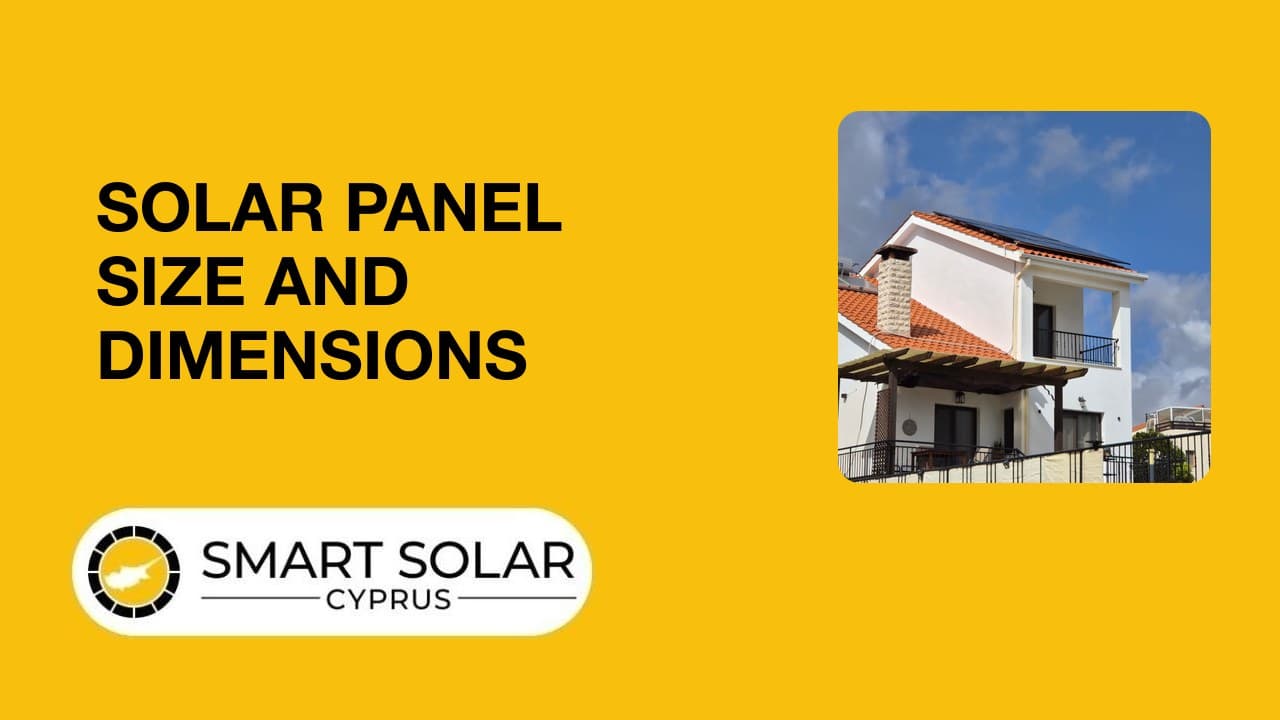
"Will it fit?" is one of the first questions we hear on a roof survey. The homeowner has a bill, a budget and a rough system size in mind, and then they look up at a flat roof already crowded with a solar water heater, two AC condensers, a water tank and the stairwell housing.
Most online answers to that question are written for American roofs and quoted in inches. They also lag behind the panels actually being sold. Residential modules have grown over the last few years, both in wattage and in physical size, and a panel quoted in 2026 is not the same shape as the one on your neighbour's roof from 2018.
This guide gives the real dimensions and weights of the panels installed in Cyprus today, how much roof each kilowatt needs, and what panel size changes about your system.
Standard solar panel dimensions in 2026
There is no single standard size, but the market has settled on a few formats, defined mainly by the size of the silicon cells and how many of them are in the panel. These are typical figures; every manufacturer's datasheet differs by a few centimetres.
- Residential format (108 half-cut cells): about 1.72 to 1.76 m long and 1.13 m wide, so roughly 1.95 to 2.0 m² per panel. Weight is usually 21 to 24 kg, and output 420 to 460 W. This is what most Cyprus homes get quoted today.
- Older residential format (120 half-cut cells): about 1.70 to 1.76 m by 1.04 m, around 1.8 m², 19 to 21 kg and 350 to 400 W. You will find these on many systems installed between roughly 2018 and 2022, and some suppliers still stock them.
- Large format (144 half-cut cells): about 2.1 to 2.4 m long and 1.13 m wide, so 2.4 to 2.7 m² each. They weigh 27 to 33 kg and produce 540 to 620 W. Mostly used on commercial roofs and ground-mounted systems.
- Utility format (210 mm cells): around 2.38 by 1.30 m, over 3 m² and well above 30 kg, at 650 W or more. Designed for solar parks, rarely sensible on a house.
Frame depth is now typically 30 to 35 mm. Glass-glass bifacial panels, such as the Luxor 450 W bifacial module, sit in the residential format and are often a little heavier than a glass-and-backsheet panel of the same size. For any quote, ask for the datasheet and read the exact length, width and weight from it rather than relying on a general figure.
Why size and wattage go together
A panel's rated wattage is mostly a function of its area and its efficiency. The rating is measured under standard test conditions of 1,000 watts of sunlight per square metre, so the arithmetic is simple:
Area × 1,000 W/m² × efficiency = rated output.
A 1.95 m² panel at 22% efficiency gives 1.95 × 1,000 × 0.22, about 430 W. A 2.0 m² panel at 23% gives 460 W.
Two things follow. First, a "bigger" panel in watts is usually a physically bigger panel. A 600 W module is not a better version of a 450 W one; it is a larger sheet of the same technology. Second, efficiency is the only way to get more power from the same footprint. If your roof space is tight, compare efficiency, and see our guide to choosing the best solar panels in Cyprus for why the temperature coefficient matters as much as the headline figure in our summers.
How much roof does each kilowatt need?
With 2026 residential panels at around 22% efficiency, the panels themselves cover about 4.5 m² per kW. Real layouts need more than that, because of gaps between rows, clearance from roof edges and the space you have to leave around everything else on the roof.
As working figures for Cyprus homes:
- Pitched or tiled roof: around 5 m² of usable roof per kW, with panels laid flush to the slope.
- Flat roof with tilted frames: around 6.5 to 7 m² per kW, because tilted rows must be spaced so they do not shade each other.
Applied to common system sizes with panels in the 430 to 460 W range:
- 3 kW, about 7 panels: roughly 15 m² on a pitched roof, 20 m² on a flat roof.
- 4 kW, about 9 panels: roughly 20 m² pitched, 27 m² flat.
- 5 kW, about 11 panels: roughly 25 m² pitched, 33 m² flat.
- 10 kW, about 22 panels: roughly 50 m² pitched, 65 to 70 m² flat.
These figures assume a clear, reasonably regular roof. Which system size you actually need depends on your consumption and your electricity supply, and our guide to what size solar system you need in Cyprus works through that from your EAC bill.
Flat roofs: row spacing is where the space goes
Most Cyprus homes have flat concrete roofs, and on a flat roof the panels sit on aluminium frames tilted towards the sun. Each tilted row casts a shadow, and the next row has to start beyond it.
The shadow length depends on how high the back edge of the panel rises and how low the sun gets. At solar noon in midwinter the sun in Cyprus is only about 31 degrees above the horizon, which is the case designers check against.
A worked example with a residential panel 1.76 m long:
- Mounted in portrait at 15 degrees: the back edge rises about 0.46 m. At a 31-degree sun that casts a shadow of roughly 0.75 m, so the next row starts at least 0.75 m behind.
- Mounted in portrait at 30 degrees: the back edge rises about 0.88 m and the gap grows to roughly 1.45 m.
- Mounted in landscape at 15 degrees: the short side (1.13 m) is the one that tilts, so the rise is about 0.29 m and the gap only about 0.5 m.
This is why most flat-roof installations here use shallower tilts of 10 to 15 degrees and often landscape rows. You lose a little yield per panel compared with the ideal 30 degrees, but you fit noticeably more panels on the same roof. Installers usually add some margin beyond the noon figure so that winter mornings and afternoons are not shaded either. Our article on solar panel direction and angle in Cyprus covers the yield side of that trade-off.
What else takes up space on a Cyprus roof
The total area of your roof is rarely the useful number. On a typical flat roof we survey, a large share is already taken:
- Solar water heater: a thermosiphon unit with two collectors and a cylinder takes around 4 to 5 m², plus the shadow it throws to the north. Moving it, or combining it with PV, is a common conversation. Our guide to solar water heating in Cyprus compares the options.
- AC outdoor units and water tanks: each needs access for servicing, and panels should not sit directly in the hot air discharge of a condenser.
- Stairwell housing and parapets: both cast shade, especially in winter. A 1 m parapet on the south side can shade the first row for much of the day in December.
- Edge clearance: panels are kept back from roof edges, where wind loads are highest, and access paths are left for maintenance and cleaning.
Once all of that is drawn on a plan, a 100 m² flat roof often has 40 to 60 m² of usable, unshaded space. That is still enough for a 5 to 8 kW system in most cases, but it is the reason a survey matters more than a measurement from satellite images.
Weight: will your roof carry it?
A residential panel weighs 21 to 24 kg, and spread across its area that comes to roughly 11 to 12 kg per square metre. Add rails and clamps on a pitched roof and the total stays around 10 to 15 kg/m².
On flat roofs the frames are usually ballasted with concrete blocks rather than bolted through the waterproofing. The ballast is calculated for the wind loads at your site, so on exposed coastal or hillside plots it can add considerably more weight than the panels themselves. Modern reinforced concrete roofs in Cyprus carry this comfortably, but an older roof, a roof with visible cracking, or a lightweight structure such as a pergola or a tiled timber roof should be checked first.
Does panel size change anything else?
Yes, in a few practical ways that rarely appear on a quote.
- Fitting the single-phase limit: homes on a single-phase supply are commonly limited to around 4.16 kWp. Nine 450 W panels make 4.05 kWp; ten 420 W panels make 4.2 kWp and go over. Panel wattage decides how close you get to the limit, so the right panel for a single-phase home is sometimes not the biggest one.
- Awkward roofs: a smaller panel is easier to fit around chimneys, roof windows and irregular shapes. A few small panels can fill a space that one large panel cannot.
- Handling and access: a 22 kg panel can be carried up a ladder to a village house roof by two installers. A 30 kg panel over 2.2 m long often needs a hoist, which adds cost and time.
- Inverter matching: large-format panels carry higher currents. An inverter or optimiser has to be rated for the panel's current, which is one reason we specify the panel and inverter together as part of a full photovoltaic system rather than separately.
- Wind and clamping: larger panels catch more wind. Manufacturers specify where along the frame they may be clamped, and following those zones matters more as panels get longer.
For most Cyprus homes, the residential format of around 1.75 by 1.13 m and 430 to 460 W is the sensible choice. Large-format panels make sense on big commercial roofs and ground mounts, where fewer panels and fewer clamps lower the installation cost.
Working out what fits on your roof
A rough check you can do yourself: measure the clear, unshaded part of your roof, divide by 5 for a pitched roof or by 7 for a flat one, and the result is roughly the kW you can fit. Then compare that with what your consumption calls for using our solar calculator.
When you are ready for an exact layout, we survey the roof, draw the panels to scale around everything already up there, and confirm the supply limit for your address. You can request a free quote and we will send a layout with the panel model, dimensions and weight stated.
Frequently Asked Questions
What are the dimensions of a 400W solar panel?
Most current 400 to 430 W panels measure about 1.72 m by 1.13 m and weigh 21 to 22 kg. Some older 400 W models are longer and narrower, about 1.75 to 2.0 m by 1.0 to 1.05 m. Always check the datasheet for the exact model.
How many solar panels fit on my roof?
Divide your clear, unshaded roof area by about 2 m² per panel on a pitched roof, or about 3 m² per panel on a flat roof with tilted rows. A flat roof with 30 m² of usable space typically takes 10 or 11 panels, around 4.5 to 5 kW.
How do I work out the size of panel I need?
Panel size follows from wattage and efficiency: rated watts equal area times 1,000 times efficiency. For a home, choose the system size from your consumption first, then pick a panel that fills your available roof and fits your supply limit with the fewest awkward gaps.
How heavy is a solar panel?
A residential panel of 420 to 460 W weighs 21 to 24 kg. Large-format commercial panels weigh 27 to 33 kg. Including mounting, a pitched-roof system adds roughly 10 to 15 kg per square metre, with ballast adding more on flat roofs.
Want a quote tailored to your roof and your bill?
A free site visit and proposal, with no obligation and no pressure.
Keep reading
All articles
Virtual Net Billing in Cyprus: Solar Without a Roof
How virtual net billing in Cyprus works: panels on one site credit the EAC bill of another. Who it suits, the 400 kWp limit, real returns and the process.
How to Read Your EAC Bill With Solar Panels in Cyprus
Your EAC bill with solar panels, line by line: import and export readings, net metering credits, Net Billing euro credits, and why the bill can still rise.
Heat Pump With Solar Panels in Cyprus: 2026 Guide
Running a heat pump on solar in Cyprus: running costs, how much PV it needs in winter, what installation costs and how Net Billing changes the sums.