
Which Way Should Solar Panels Face in Cyprus?
The best direction and tilt angle for solar panels in Cyprus: why due south is not always the right answer under Net Billing, and what flat roofs need.
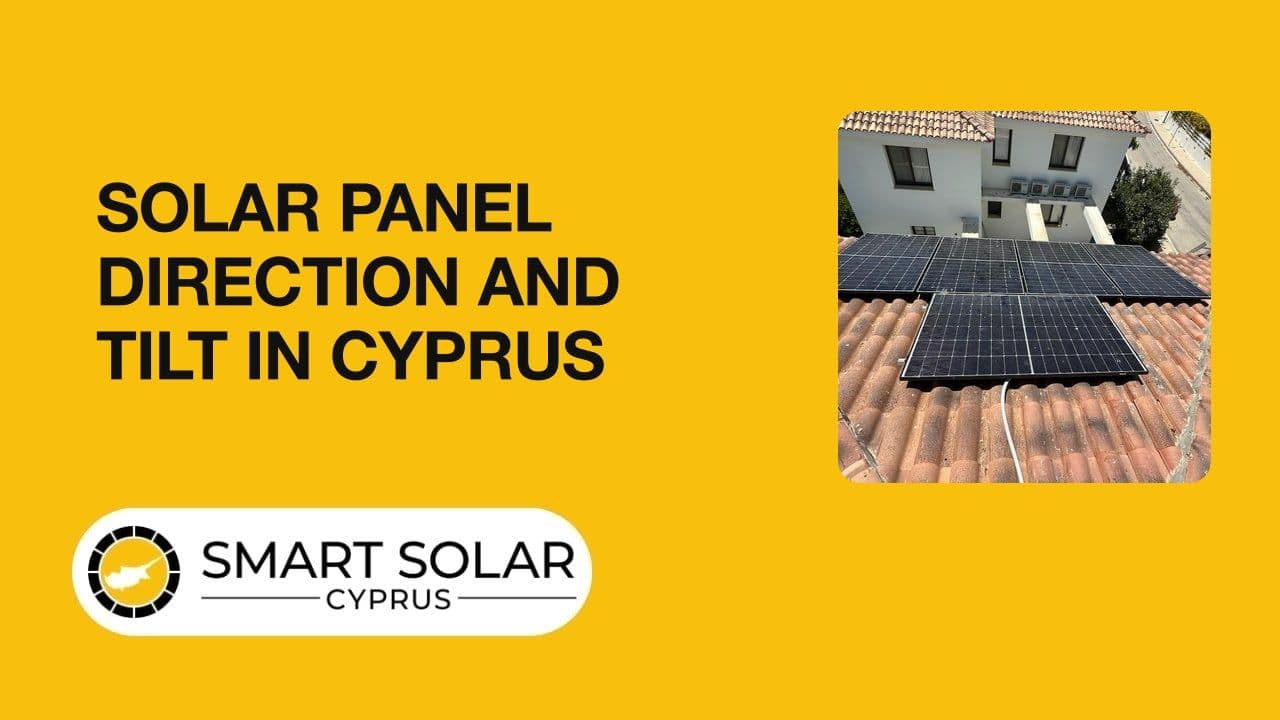
Search this question and you will get answers written for Britain, Germany or Ohio. Face them south, tilt them at 40 degrees, done. None of that is much use on a concrete roof in Limassol.
Cyprus sits at about 35 degrees north. The sun climbs higher here, the useful daylight is longer, and most roofs are flat rather than pitched, which means the angle is something you choose rather than something the builder chose for you. The rules are genuinely different.
There is also a newer reason to think about it harder. Since Net Billing took over for all new connections in January 2026, the value of a kilowatt-hour depends on when it arrives, not just how many you collect.
The short answer for a Cyprus roof
If you want a single number to hold in your head: due south, tilted around 30 degrees, gives the highest annual production in Cyprus. That is the geometric optimum at this latitude, and it is what a well-sited system needs to reach roughly 1,700 kWh per kW installed each year.
The longer answer is that the optimum is a broad plateau rather than a sharp peak. Anything from south-east to south-west loses only a few percent, and tilts between 15 and 35 degrees sit within a few percent of each other. You lose far more to a badly placed water tank than to being 20 degrees off south.
And on a flat roof, where you are free to point the panels anywhere, the highest annual total is not automatically the most valuable one.
Why due south is not always the right answer now
Under Net Billing, the two halves of your production are priced very differently. Electricity you use in the house as it is generated replaces power you would have bought at roughly €0.25 to €0.30 per kWh. Electricity you export earns the wholesale rate instead, around €0.08 to €0.10 per kWh. Our guide to how net billing works in Cyprus sets out the mechanics.
A due-south array produces a tall, narrow curve that peaks near solar noon. That is excellent if you are home at midday with the air conditioning on or a pool pump running. It is less useful if the house is empty until six, because the peak lands when nobody is there and most of it leaves at the export rate.
Turning part of the array west flattens that curve. You lose some annual kilowatt-hours but you gain output in the late afternoon, when Cyprus households start cooking, cooling and charging. A kilowatt-hour at five in the afternoon that you actually use is worth roughly three times an exported kilowatt-hour at noon.
So the honest rule is this: maximise the annual total when you export a lot or have a battery to soak up the midday peak, and shift towards west when your consumption is concentrated in the afternoon and evening.
What each orientation actually costs you
Approximate annual production against a due-south array at optimum tilt, for a roof at Cyprus latitude:
- Due south: the benchmark. Highest annual yield, sharpest midday peak.
- South-east or south-west: roughly 2 to 4 percent less. Close enough that it should never drive a design decision.
- Due east or due west: roughly 10 to 15 percent less across the year, depending on tilt. Shallower tilts narrow the gap. East gives you a morning-weighted curve, west an afternoon-weighted one.
- Due north: roughly 25 to 35 percent less. Worth avoiding, though a few panels on a north slope can still be justified if the alternative is no system at all.
These are modelling figures, not measurements from your roof. A proper design runs your coordinates, roof planes and shading through simulation software and gives month-by-month numbers. Treat a quote that cannot show you that as incomplete.
Getting the tilt right
The sun is much higher here than most online guides assume. At solar noon in Cyprus it reaches about 78 degrees above the horizon at midsummer and about 31 degrees at midwinter.
That spread is what the tilt angle trades between:
- Around 30 degrees gives the best annual total, balancing the two seasons.
- Steeper, 35 to 40 degrees, favours winter, when the sun is low and production is scarce. It helps if your winter consumption is heavy, for example electric heating.
- Shallower, 10 to 15 degrees, favours summer and is what most Cyprus flat-roof installations actually use, for reasons that have nothing to do with the sun.
The penalty for laying panels completely flat, at zero degrees, is around 8 to 10 percent of annual output compared with 30 degrees. That is real but not catastrophic. The bigger problem with flat-laid panels is dirt, which we come back to below.
Flat concrete roofs: space is the real constraint
On a pitched tile roof, the panels follow the tiles and there is not much to decide. On the flat concrete roofs that dominate Cyprus housing, you choose the angle, and the choice is mostly about how much roof you have.
Tilted rows shade the row behind them when the sun is low. To keep the winter sun off the back rows you have to leave a gap, and the steeper the tilt, the bigger the gap. For a typical 450 W panel mounted portrait, going from 10 degrees to 30 degrees needs roughly a third more roof length for the same number of panels. The clear gap between rows nearly triples.
That arithmetic is why most Cyprus flat-roof arrays are set at 10 to 15 degrees. You give up a few percent per panel and get considerably more panels on the roof, which nearly always wins. If the roof is large enough that space is not the binding constraint, go steeper.
Two other flat-roof points worth raising with your installer:
- Ballast and wind. Frames on a flat roof are usually weighted rather than drilled, which avoids penetrating the waterproofing. The ballast has to be calculated for the wind loads at your site, particularly on exposed coastal and hillside plots.
- Reflected light. Bifacial modules such as the Luxor 450 W bifacial panel collect light from the rear as well, and a pale concrete roof reflects a useful amount of it. It is a few percent, not a transformation, but on a flat roof it comes essentially free.
East and west splits
Splitting an array between an east face and a west face is common on Cyprus roofs, sometimes because the roof is shaped that way and sometimes by choice.
Each half misses the midday peak, so the combined annual total is around 10 to 15 percent below a south array of the same size. In return you get a wider production curve: generation starts earlier, ends later, and sits at a more even level through the day.
For a household under Net Billing, that flatter curve often converts into more self-consumption and a better financial result than the higher annual figure, particularly with an evening-heavy load pattern. It also plays well with storage, because the battery has a longer window to charge. Our page on battery storage covers how that pairing works in practice.
Shading costs more than orientation ever will
Homeowners agonise over 15 degrees of azimuth and then accept a chimney shadow across the array at four in the afternoon. The shadow is the bigger problem.
Panels in a string behave like a chain. Shade one and the current through the whole string drops. Bypass diodes limit the damage to part of a panel, but a persistent shadow still costs far more than the area it covers.
Common Cyprus culprits, in rough order of how often we find them:
- Solar water heaters and their tanks. Almost every older Cyprus roof has one, and the tank is tall enough to throw a long shadow in winter.
- Parapet walls. Standard on flat roofs, and low winter sun turns a 1 m parapet into several metres of shade on the southern edge.
- Condensers, aerials and satellite dishes. Easy to relocate before installation, awkward afterwards.
- Neighbouring buildings and trees. The one you cannot fix. It needs to be modelled across the year, not eyeballed in August when the sun is at its highest.
Where shading is unavoidable, power optimisers or microinverters let each panel operate independently, so a shaded module no longer drags its neighbours down. They add cost and are worth it on a genuinely obstructed roof, not on a clear one.
Dirt, dust and the low-tilt trap
Cyprus gets Saharan dust, long rainless spells and pollen. Rain is what normally rinses a panel, and it only runs off properly if the panel is tilted. Below about 10 degrees, water sits and evaporates, leaving the dust behind and building a film along the bottom edge of the frame.
That is the practical argument against laying panels dead flat: the modelled loss is 8 to 10 percent, but after a dusty summer the real loss can be larger. A minimum of about 10 degrees, plus washing the array once a year, holds output close to where it should be. Our solar panel maintenance guide sets out the yearly tasks.
What to ask before you sign
Orientation and tilt belong in the quote, not left to the installation crew on the day. Reasonable questions:
- What azimuth and tilt is each roof plane in the design, and what annual yield does the simulation give for each?
- How was shading modelled, and at what times of year?
- On a flat roof, what row spacing and what ballast calculation are you using?
- If part of the array faces east or west, what does that do to my self-consumption rather than just my annual total?
If you want that worked out against your own roof and your own bills, a free site assessment produces a design with the orientation, tilt and monthly yield written down. For a first estimate before that, the savings calculator takes about a minute, and the guide to what size system you need covers the capacity side of the same question. Either way, good system design starts with the roof rather than the price list.
Frequently Asked Questions
What is the best direction for solar panels in Cyprus?
Due south gives the highest annual production. South-east and south-west are within a few percent and make almost no practical difference. West-facing panels produce around 10 to 15 percent less over the year but deliver more of it in the late afternoon, which is often worth more under Net Billing if your household uses power in the evening.
What angle should solar panels be tilted in Cyprus?
About 30 degrees gives the maximum annual yield at Cyprus latitude. Most flat-roof installations here use 10 to 15 degrees instead, because shallower rows need less spacing and fit more panels on the same roof. The production lost per panel is smaller than the production gained by fitting more of them.
Is it better to have solar panels flat or angled?
Angled. Laying panels flat costs roughly 8 to 10 percent of annual output compared with 30 degrees, and it stops rain rinsing dust off, so real-world losses in a Cyprus summer can be worse than the model suggests. Keep at least 10 degrees of tilt so water runs off.
Are east and west facing solar panels worth it in Cyprus?
Often, yes. An east-west split produces about 10 to 15 percent less each year than a south-facing array, but it spreads generation across a longer day instead of concentrating it at noon. Where the household consumes power in the morning and evening, more of that output gets used at the retail rate rather than exported at the wholesale rate.
How much does shading reduce solar panel output?
More than most people expect, because panels are wired in strings and a shaded module pulls down the ones connected with it. A parapet wall, a solar water heater tank or a chimney can cost far more output than the roof area it shades. Power optimisers or microinverters isolate each panel and are the usual fix on obstructed roofs.
Want a quote tailored to your roof and your bill?
A free site visit and proposal, with no obligation and no pressure.
Keep reading
All articles
Solar Air Conditioning in Cyprus: What Actually Works
How to run air conditioning on solar in Cyprus: how many panels one aircon needs, whether DC solar air conditioners are worth it, and what it costs.
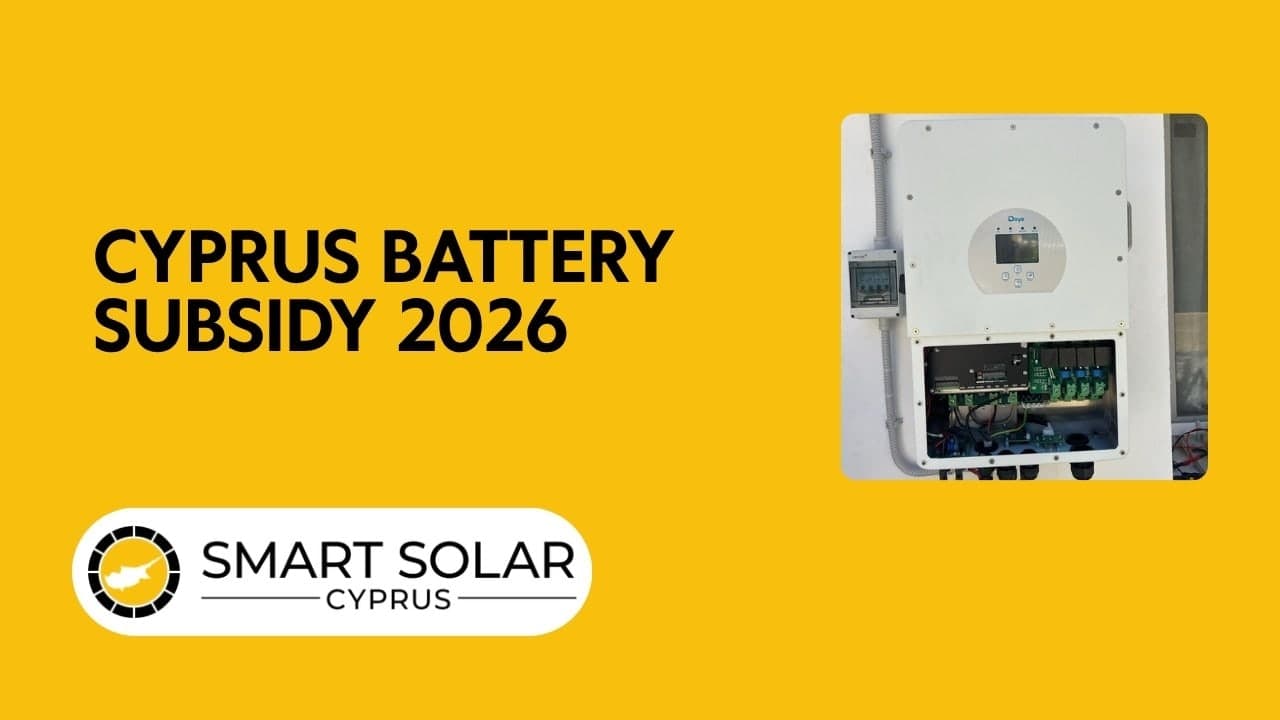
Solar Battery Subsidy in Cyprus: What's Coming in 2026
Cyprus has promised a home battery subsidy but nothing has opened. What has been said, what the September grant covers, and how to be ready on day one.
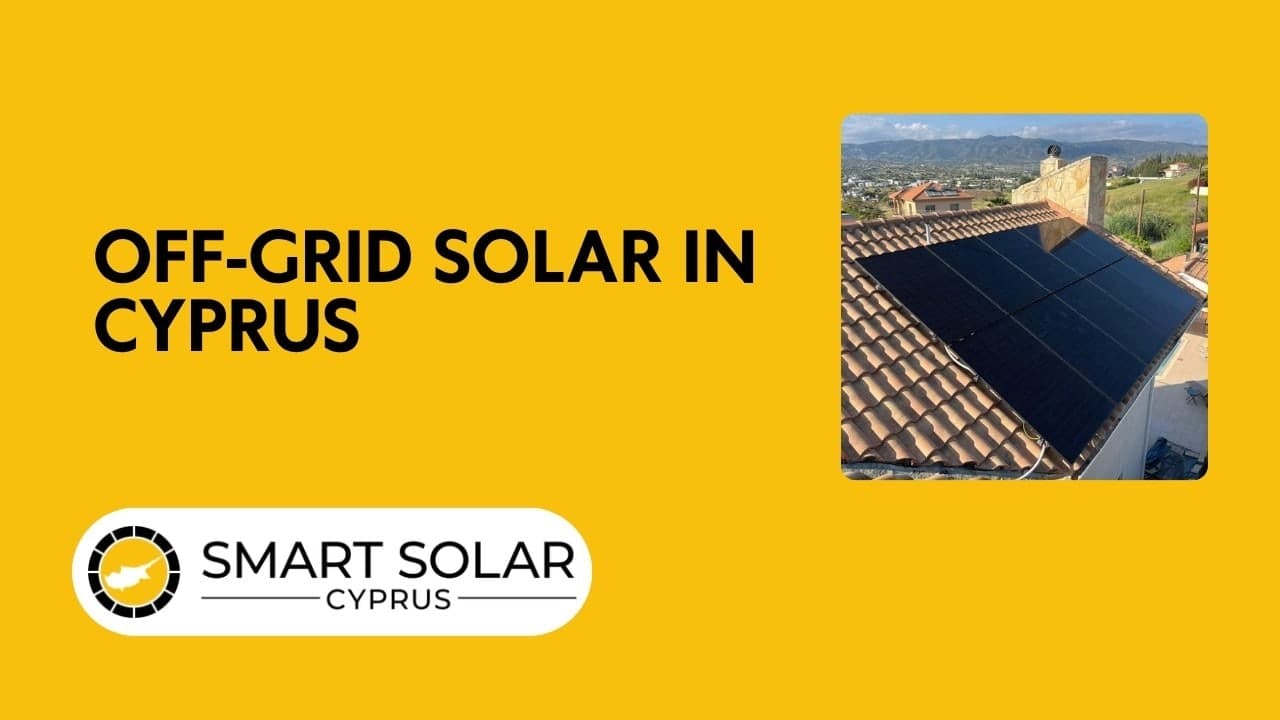
Off-Grid Solar Systems in Cyprus: Costs and Sizing
What a genuine off-grid solar system costs in Cyprus, how to size panels and battery for December, and when a grid connection is still the cheaper answer.