
Net Billing in Cyprus (2026): How It Works vs Net Metering
How net billing works for every new solar system in Cyprus since 2026: what exports earn, what changed from net metering, and how to keep payback at 4-6 years.
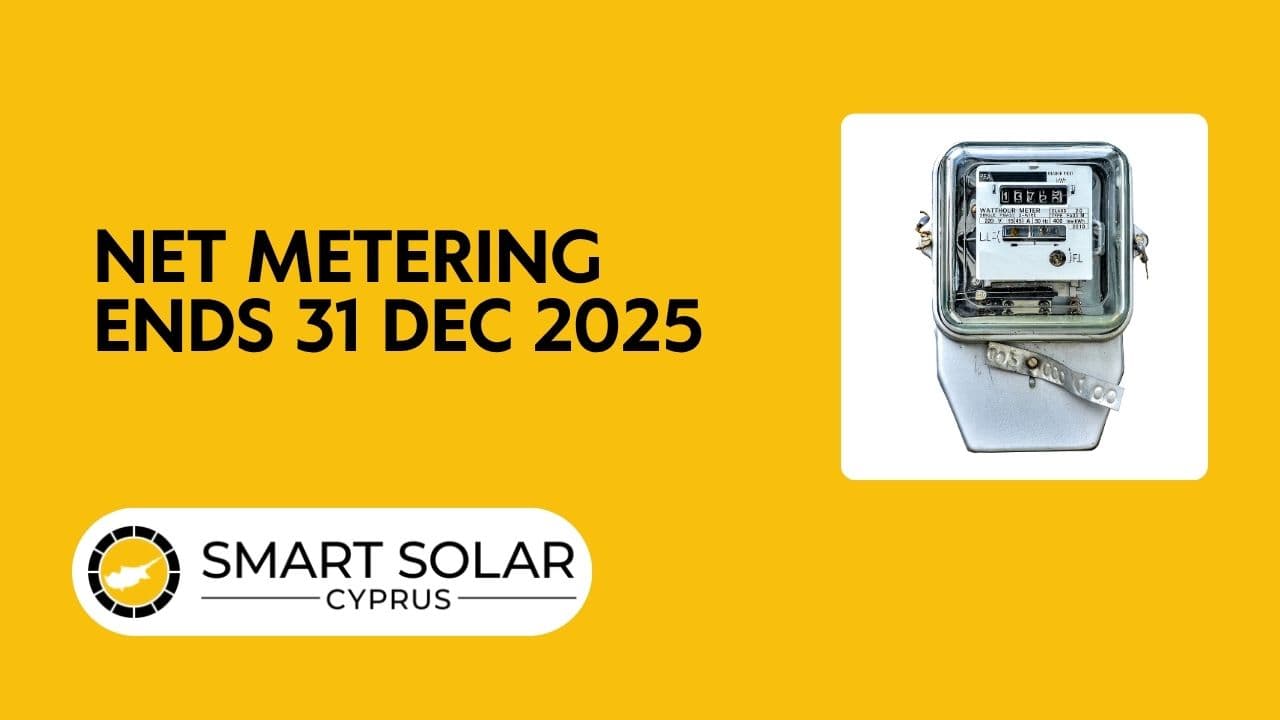
Updated July 2026. This article originally compared the two schemes ahead of the net-metering deadline. That window has closed: after two extensions, net metering stopped accepting new applications on 31 December 2025, and since 1 January 2026 every new photovoltaic system in Cyprus connects under net billing. Here is what the change means in practice, what your exported energy actually earns now, and how new installations still reach net-metering-level savings.
The Short Version
- Net metering is closed to new applicants. If you already have a net-metering contract, your arrangement continues unchanged for its full term.
- Net billing is now the default for all new residential and commercial systems, scaling up to 8 MW.
- The maths changed, not the opportunity. With the right system design, self-consumption first and storage where it fits, payback in Cyprus remains among the best in Europe.
Why Cyprus Dropped Net Metering
Net metering was a victim of its own success. More than 88,000 households and small businesses installed photovoltaic systems in Cyprus, over 81,000 of them under net metering, and in 2024 alone the island added roughly 159 MW of new solar capacity. On sunny spring days, midday production now regularly exceeds what the grid can absorb, forcing the operator to curtail generation.
Net metering made that problem worse by design: it rewarded exporting as much as possible, whenever the sun happened to shine, at full retail value. The replacement framework, designed by the Cyprus Energy Regulatory Authority (CERA) and introduced alongside the liberalisation of the electricity market, does the opposite. It rewards using your own production and storing the surplus, and it prices exports at what they are actually worth to the market at that moment.
We covered the policy timeline in detail in our article on the end of net metering in Cyprus.
Net Metering: How the Old Gold Standard Worked
Under net metering, your solar system worked like a perfect energy bank:
- 1-to-1 exchange: every kWh you sent to the grid equalled one kWh credit
- Annual balance: summer surplus covered winter needs
- Simple maths: produce 5,000 kWh yearly = offset 5,000 kWh of bills
- Zero bills possible: size the system right and electricity costs all but disappeared
A typical Limassol home with a 6kW system producing 9,600 kWh against 9,000 kWh of consumption paid essentially €0 plus small grid fees, with every exported kWh credited at the full retail rate of around €0.25/kWh. That generosity is exactly why the scheme was closed to new entrants.
Net Billing: The Rules Since January 2026
Net billing changes how your exported energy is valued:
- Sell at wholesale, buy at retail: surplus exported to the grid earns the wholesale market rate (roughly €0.08-0.10/kWh), while evening imports cost the full retail rate (around €0.25/kWh)
- Self-consumption is king: every kWh you use directly from your panels is still worth the full retail price you'd otherwise pay EAC
- Monthly settlement: no annual balancing like net metering
- Bigger systems allowed: net billing scales from homes to 8 MW commercial installations, and virtual net billing lets you offset consumption at a different meter
The wider framework also gives self-consumers three routes for their surplus now that the EAC's monopoly on these arrangements has ended: a bilateral agreement with an energy retailer on terms you negotiate, an aggregator who sells your surplus on the market for you, or no export at all. For a typical household the difference between these routes is small; the design principles below apply to all of them.
What Your Exports Actually Earn
The question we hear most often is what the "net billing tariff" is. There isn't a single fixed number. Your exports are credited at the wholesale value of electricity at the time you export, and because every solar roof in Cyprus exports at the same sunny midday hours, that value is usually at its daily low, in practice roughly €0.08-0.10 per kWh.
Meanwhile the electricity you import in the evening is charged at your normal retail tariff, around €0.25 per kWh for households and rising. One kWh exported at noon and bought back at 8pm costs you the difference, about €0.16. Multiply that by a few thousand kWh a year and you have the entire financial story of net billing: the scheme punishes the export-and-reimport pattern that net metering used to make free.
Same Limassol Home Under Net Billing
Take the identical 6kW system, now connected under net billing with no design changes:
- Daytime excess sold at ~€0.09/kWh (wholesale)
- Evening usage bought at ~€0.25/kWh (retail)
- Annual bill: €800-1,200 instead of €0
That gap is real, but it is also avoidable. The shortfall comes almost entirely from exporting cheap and importing dear. Close that loop and the economics recover.
How to Win Under Net Billing in 2026
Our German-trained engineers design every 2026 system around three levers:
- Self-consumption first. Shift consumption into daylight hours: water heating, pool pumps, washing, EV charging. Your own panels then cover it at full retail value.
- Battery storage where it fits. A battery banks your midday surplus instead of selling it at €0.09, then discharges it in the evening instead of buying at €0.25. That €0.16/kWh spread is the net billing business case, and it is why storage went from optional to default. See our complete battery storage guide for sizing and costs.
- Right-sized arrays. Under net metering, oversizing was harmless. Under net billing, every excess kWh earns wholesale rates, so we size precisely to your real consumption profile.
Designed this way, a typical home system in 2026 still reaches payback in roughly 4-6 years.
The 2026 Grants: Batteries Instead of Panels
Government support has shifted rather than disappeared. The €1,500 PV grant ended with the "Photovoltaics for All" scheme, and the incentive programme that replaced it points at storage: to qualify for a grant, a new solar system must include a battery. Funding comes from national resources, and the Ministry of Energy publishes the amounts and conditions of each call.
Two practical notes from the installations we have quoted this year. First, the grant conditions have been a moving target, so check the current terms before you commit; we track them so you don't have to. Second, even without a grant, a 10kWh battery at today's installed prices of €800-1,000 per kWh pays for itself in about 6-8 years on the €0.16 spread alone, and any grant shortens that.
Already on Net Metering? Here's What You Keep
Existing net-metering customers keep their contracts and their 1:1 credits. You don't need to do anything. Three things worth knowing:
- Your arrangement continues under its existing terms for the full contract period: 15 years for residential systems, 10 for commercial. The last net-metering contracts will run until around 2040.
- New applications are what closed, not existing contracts. When your contract eventually expires, your system switches to the self-consumption rules in force at that time.
- A battery can still make sense for you today (backup power, EV charging, outage protection), but it is not financially essential the way it is for new net billing connections.
What This Means If You're Installing in 2026
The deadline conversations are over; the design conversations matter now. The difference between a well-designed and a badly-designed net billing system is bigger than the difference between net metering and net billing ever was. A system built for export will disappoint; a system built for self-consumption will perform.
When you compare quotes, ask each installer two questions. How did you estimate my self-consumption share, and what happens to my payback if it is 10 points lower? An installer who has modelled your actual consumption profile will have answers; one who has sized your roof by square metres will not.
Frequently Asked Questions
What is the difference between net metering and net billing in Cyprus? Net metering credited every exported kWh one-to-one against a kWh imported later, both at retail value. Net billing, which applies to all new systems since 1 January 2026, credits exports at the wholesale market rate (roughly €0.08-0.10/kWh) while imports still cost the full retail rate (around €0.25/kWh). Self-consumed solar keeps its full retail value under both schemes.
What is the net billing tariff in Cyprus? There is no fixed tariff. Exports earn the wholesale market value at the time of export, in practice roughly €0.08-0.10 per kWh, settled monthly. Imports are charged at your normal retail tariff.
Is solar still worth it in Cyprus under net billing? Yes. Every kWh you consume from your own panels replaces one you would buy at around €0.25. A system sized to your consumption, with usage shifted into daylight and storage where it fits, typically pays back in 4-6 years.
Do I need a battery under net billing? Not to connect, but you do need one to qualify for the 2026 state grants, and the €0.16/kWh gap between export and import prices means a correctly sized battery pays for itself in about 6-8 years regardless.
Next step: book a free roof assessment and we'll model your real consumption against the current net billing rules: array size, storage options, and honest payback maths using your actual EAC bills. Try our solar calculator for a first estimate.
Want a quote tailored to your roof and your bill?
A free site visit and proposal, with no obligation and no pressure.
Keep reading
All articles
How to Read Your EAC Bill With Solar Panels in Cyprus
Your EAC bill with solar panels, line by line: import and export readings, net metering credits, Net Billing euro credits, and why the bill can still rise.

Heat Pump With Solar Panels in Cyprus: 2026 Guide
Running a heat pump on solar in Cyprus: running costs, how much PV it needs in winter, what installation costs and how Net Billing changes the sums.

Solar Water Heating in Cyprus: Thermal vs PV in 2026
Your solar water heater's electric element versus heating water with surplus photovoltaic power. What each costs in Cyprus and which wins in 2026.