
Best Solar Panels in Cyprus: How to Choose (2026)
How to choose the best solar panels in Cyprus in 2026: panel technology, heat performance, efficiency, warranties, and what actually pays off.
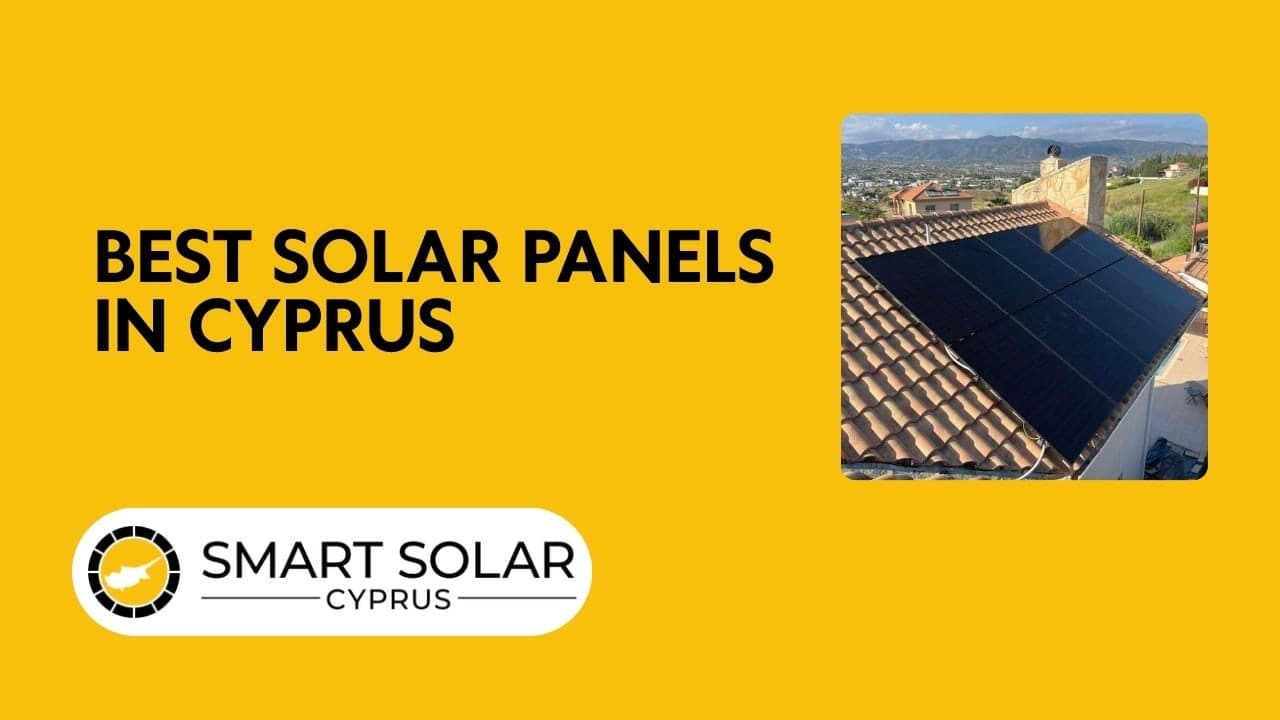
Ask ten installers which solar panels are best and you will get ten different answers, usually pointing at whatever brand they happen to stock. That is not much help when you are the one paying for the system and living with it for the next 25 years.
The honest answer is that "best" depends on where you live, and Cyprus is a demanding place for a solar panel. Roof surfaces here routinely pass 60–70°C in July, and every degree of heat quietly shaves output off a working module. A panel that tops the efficiency charts in a German lab can be beaten by a sturdier one on a Nicosia rooftop in August. So the panel that is best for Cyprus is the one that keeps producing when it is hot, holds up to years of sun and dust, and comes with a warranty you can actually rely on.
This guide walks through what separates a good panel from a cheap one, the technologies you will see on quotes in 2026, and how to match the panel to your roof and to the new Net Billing rules.
What makes a solar panel "the best" in Cyprus?
Panel spec sheets lead with efficiency, but that is only part of the story. For a Cyprus home, four things matter more than the headline wattage:
- Heat performance: how much output the panel loses as it warms up, measured by its temperature coefficient. This is the single most Cyprus-specific factor.
- Real-world durability: resistance to heat cycling, UV, salt air near the coast, and dust — the conditions that age a panel here far faster than in northern Europe.
- Efficiency per square metre: how much power you get from a limited roof, which decides whether you can fit the system you actually need.
- Warranty and the company behind it: a 25- or 30-year promise is only worth as much as the manufacturer still trading to honour it.
Get those right and the exact brand name matters less than the sales pitch suggests. A well-chosen mid-premium panel will comfortably outlast its payback period and keep earning for two decades after.
Panel technology in 2026: PERC, TOPCon and HJT
Almost every quality residential panel sold in Cyprus today is monocrystalline silicon — the uniform black cells you see on modern roofs. Within that, three cell technologies dominate:
- Mono PERC: the long-standing workhorse. Reliable, affordable, and still perfectly good for most homes, with efficiencies around 20–21%.
- TOPCon: the current mainstream upgrade. Slightly higher efficiency (around 22–23%) and a better temperature coefficient than PERC, so it holds output better in heat — a genuine advantage in Cyprus.
- HJT (heterojunction): a premium technology with excellent heat tolerance and very low long-term degradation. It costs more, and the extra yield only pays back on roofs where every kilowatt-hour counts.
You will also see bifacial panels, which generate a bonus from light reflected onto their rear side. On a flat roof with a reflective surface or light gravel, and with the right mounting, bifacial modules such as the Luxor 450W bifacial can add a few extra percent of yearly output for little extra cost. On a tightly fitted tiled roof the rear-side gain is smaller, so it is worth having your installer assess it honestly rather than paying for a feature your roof cannot use.
Do not get lost in the acronyms. The right question is not "which technology wins on paper" but "which panel gives the best return on my roof, in my climate, at this price". A newer cell type is only better if it earns back its premium.
Why the temperature coefficient matters here
If you read one number on a spec sheet, make it the temperature coefficient of power (often written as Pmax, in %/°C). It tells you how much output the panel loses for every degree above 25°C.
Panels are rated at a cell temperature of 25°C, but in a Cyprus summer the cells sit far hotter. A module on a hot roof can easily run 30–40°C above the air temperature. With a typical coefficient of around −0.34%/°C, a panel that is 40°C over its rated temperature loses roughly 13–14% of its output in that moment. A better panel with a coefficient nearer −0.29%/°C loses noticeably less, and over thousands of hot afternoons that gap adds up to real money.
This is why the flashiest efficiency figure is not the whole picture in Cyprus. A slightly less efficient panel with strong heat tolerance can out-produce a "more efficient" one across a full summer. When you compare quotes, ask for the temperature coefficient, not just the wattage.
Efficiency versus price: what actually pays off
Higher efficiency means more watts from the same roof area. That matters most when your roof is small, shaded in places, or cluttered with water tanks and skylights — situations where you simply cannot fit enough standard panels to cover your bills.
If you have a large, clear, well-oriented roof, you often do not need to pay a premium for the highest-efficiency modules; you can just fit a few more standard panels and reach the same total output for less. Under Net Billing, though, the calculation tilts back towards quality. Since exported energy now earns only the wholesale rate while imported energy costs the full retail rate, the value is in generating and using your own power during the day. Panels that produce more in the heat of the afternoon — exactly when your air conditioning is running — are worth paying a little more for.
For a sense of how panel choice feeds into overall system pricing, see our 2026 price guide, and for how the money now flows under the new rules, our explainer on net metering versus Net Billing.
Tier-1 brands and what warranties really tell you
"Tier 1" is a banking term for a manufacturer's financial stability, not a quality grade — but it is a useful filter. A Tier-1 maker is large, established, and far more likely to still exist in 20 years to honour a claim. That matters, because a warranty is a promise, and a promise is only as good as the company making it.
Read two warranties on every quote:
- The product warranty covers manufacturing defects — the panel itself. Budget panels often offer 10–12 years; strong panels offer 25 years; the best, such as the German-engineered modules we fit, carry 30 years.
- The performance warranty guarantees a minimum output over time. A good panel promises to still deliver around 87–92% of its original output after 25–30 years, degrading only about 0.4–0.5% a year.
Be wary of a very cheap quote built on an unfamiliar brand with a short product warranty. The saving is real today, but you may pay for it in lost output or an orphaned warranty later. We cover the wider trade-offs in our guide to choosing the right photovoltaic system.
Matching the panel to your roof and your goals
The best panel on paper is not automatically the best for your home. A quick, honest site assessment should shape the choice:
- Small or complex roof: favour higher-efficiency TOPCon or HJT panels to fit more output into limited space.
- Large, simple roof: solid mid-range mono PERC or TOPCon panels usually give the best value per euro.
- Flat roof with room behind the panels: bifacial modules can add worthwhile extra yield.
- Coastal home: prioritise durability and corrosion resistance for the salt air.
- Planning a battery: if you want to store daytime surplus for the evening, pair quality panels with a hybrid inverter and see our battery storage options.
Because Cyprus enjoys some of the highest solar irradiance in Europe, almost any decent panel will produce well here. The difference between good and great is measured over decades, not in the first year — which is exactly why the panel and the installer both need to be around for the long haul.
Getting the right panels for your home
We fit high-efficiency, German-engineered panels with a 30-year warranty because, after years of installing across Cyprus, they give our customers the most dependable long-term return in this climate. But the right specification still depends on your roof, your bills, and how you use power through the day.
Start with our savings calculator for an instant estimate, then book a free site visit and we will design a full photovoltaic system around your home — with a panel choice we can justify, not just sell.
Frequently Asked Questions
Which solar panel brand is best in Cyprus?
There is no single winner, but the best choice is a Tier-1, monocrystalline panel with a strong temperature coefficient and a long warranty from a manufacturer likely to still be trading in 20 years. We fit German-engineered 450W panels with a 30-year warranty because they hold output well in Cyprus heat and back it with a promise that lasts.
What is the most efficient solar panel right now?
The most efficient residential panels in 2026 use HJT or high-end TOPCon cells and reach roughly 22–23% efficiency. For most Cyprus homes, though, the highest efficiency is not the best value — a slightly less efficient panel with better heat tolerance can produce more across a hot summer and cost less.
Are solar panels worth it in Cyprus?
Yes. Cyprus has some of the highest solar irradiance in Europe and expensive grid electricity, so a well-chosen system typically pays for itself in around three years and then generates savings for decades. Under Net Billing, using your own power and adding a battery makes the return even stronger.
Do more expensive panels save more money?
Not always. On a large, clear roof, standard panels often deliver the same output for less. Premium panels pay off when your roof is small, when you want maximum daytime generation under Net Billing, or when you value the longer warranty and lower degradation over 25–30 years.
How long do solar panels last in the Cyprus heat?
Quality panels are built to last 25–30 years or more, even in Cyprus conditions. They lose only around 0.4–0.5% of output a year, so a good panel still delivers close to 90% of its original production after a quarter of a century. Durability and heat tolerance matter more here than in cooler climates.
Want a quote tailored to your roof and your bill?
A free site visit and proposal, with no obligation and no pressure.
Keep reading
All articles
How to Read Your EAC Bill With Solar Panels in Cyprus
Your EAC bill with solar panels, line by line: import and export readings, net metering credits, Net Billing euro credits, and why the bill can still rise.
Heat Pump With Solar Panels in Cyprus: 2026 Guide
Running a heat pump on solar in Cyprus: running costs, how much PV it needs in winter, what installation costs and how Net Billing changes the sums.
Solar Water Heating in Cyprus: Thermal vs PV in 2026
Your solar water heater's electric element versus heating water with surplus photovoltaic power. What each costs in Cyprus and which wins in 2026.