
The End of Net‑Metering in Cyprus: What Homeowners Need to Know
Net metering closed on 31 December 2025. What replaced it, how net billing values your solar, what existing owners keep, and where batteries fit in.
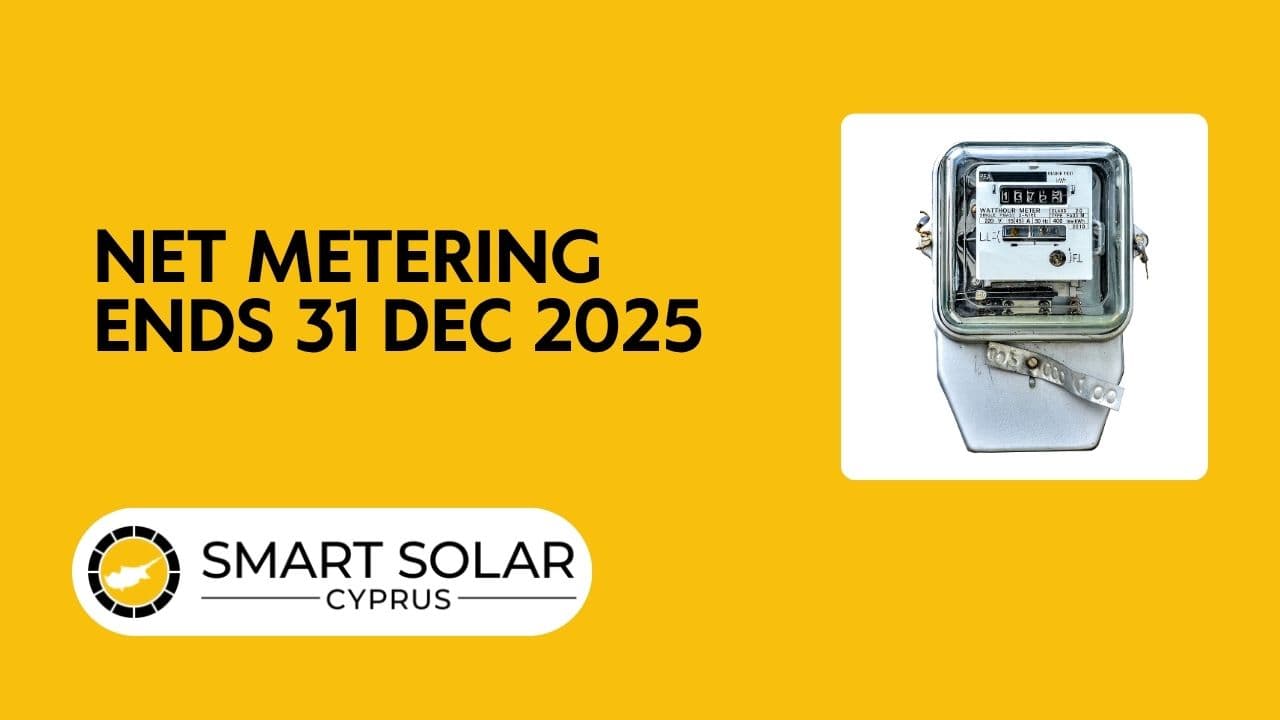
Cyprus has experienced a solar energy boom over the past decade, driven by strong government incentives and the simplicity of the net metering model. Tens of thousands of households invested in photovoltaic (PV) systems to reduce electricity bills and protect themselves from rising energy costs.
Since 1 January 2026, Cyprus is in a new phase of solar policy. Traditional net metering is no longer available for new applicants, and the long-running "Photovoltaics for All" subsidy scheme has ended. In its place: a market-based self-consumption framework that values exported solar differently, and a new grant approach built around battery storage.
Updated July 2026 to reflect how the transition has played out in practice.
End of "Photovoltaics for All" and Net Metering
The "Photovoltaics for All" scheme officially expired on 31 December 2025, closing the door on net metering for new solar installations. The Ministry of Energy originally planned to stop accepting applications on 1 August 2025, then extended the deadline to 1 October, and finally to the end of the year after public demand.
Under the net metering model, homeowners were able to export excess electricity to the grid and receive kilowatt-hour (kWh) credits. These credits could later be used to offset electricity consumption on a one-to-one basis at retail value, making solar extremely attractive and financially predictable.
From 1 January 2026, this model no longer applies to new applicants.
What Replaces Net Metering: Net Billing
New installations now connect under net billing, inside a wider market-based self-consumption framework designed by the Cyprus Energy Regulatory Authority (CERA).
Under net billing:
- Electricity exported to the grid is credited at real-time market value
- Electricity imported from the grid is charged at full retail price
- Exported energy can no longer be "banked" as kWh credits
The framework arrived together with the liberalisation of the Cypriot electricity market, which ended the EAC's monopoly on these arrangements. Self-consumers now have three routes for their surplus: a bilateral agreement with an energy retailer (terms agreed between you and the supplier), an aggregator who sells your surplus on the market, or simply not exporting at all.
The practical consequence is the same in every case: a kWh you use yourself is worth full retail price, while a kWh you export is worth a fraction of that. Self-consumption, not export, is now what makes solar pay. We walk through the numbers in our net billing guide.
Battery Storage: From Optional to Central
One of the biggest changes in the new solar policy is the role of battery storage.
To qualify for state grants under the new programme, solar PV systems must include an energy storage system. Funding comes from national resources rather than EU schemes, and the Ministry publishes the amounts and conditions for each call. Ask us for the current status when you plan your system, because the terms have been a moving target.
The aims behind the storage requirement are practical:
- Reduce grid congestion during peak solar production hours
- Minimise energy dumping when midday production exceeds demand
- Improve grid stability
- Encourage households to consume their own solar energy
A battery raises the upfront cost, but under net billing it does the job the grid used to do for free: it stores your midday surplus and gives it back in the evening, when imported electricity costs €0.25 or more per kWh. Our battery storage guide covers sizing, prices and payback in detail.
Solar Adoption in Cyprus: 88,000 Systems and Counting
Solar adoption across Cyprus reached impressive levels before the rules changed. More than 88,000 households and small businesses have photovoltaic systems installed nationwide, and over 81,000 of them were connected under net metering.
The pace tells the same story: in 2024 alone, Cyprus added roughly 159 MW of new solar capacity, about 100 MW of it from self-consumption systems on homes and businesses. That success is precisely why the policy changed. On sunny spring days, midday production now regularly exceeds what the island's grid can absorb, which forces curtailment and pushed regulators toward storage and market-based pricing.
What Happens to Existing Net Metering Systems?
If you already have a signed net metering contract, nothing changes for you today. Existing contracts continue until the end of their term: 15 years for residential systems and 10 years for commercial ones. The last net metering contracts will therefore run until around 2040.
Two groups did transition automatically to the new framework on 1 January 2026: systems that had no signed net metering or net billing contract by 31 December 2025, and systems whose contracts expire after that date. When your contract eventually ends, your system keeps producing; it simply switches to the current self-consumption rules, and a battery retrofit is usually the way to preserve most of your savings.
What This Means for Homeowners
Solar in Cyprus still pays, but the design brief has changed:
- Size for your own consumption, not for export. Under net metering, oversizing was harmless. Under net billing, surplus kWh earn market rates, so a system matched to your real usage pays back faster.
- Plan for a battery from day one. It is required for grants and it converts low-value exports into full-value evening self-consumption. Payback for a well-sized battery currently runs 6-8 years.
- Existing net metering owners should sit tight. Your contract is protected for its full term. Use these years to plan the eventual switch.
- Get the timing of grants right. Calls open and close, and conditions change. Check the Ministry's announcements or ask us before you commit.
If you want to see what the new rules mean for your own roof and bill, our solar calculator gives you a first estimate in two minutes, and a free site visit turns that into a fixed quote.
Want a quote tailored to your roof and your bill?
A free site visit and proposal, with no obligation and no pressure.
Keep reading
All articles
How to Read Your EAC Bill With Solar Panels in Cyprus
Your EAC bill with solar panels, line by line: import and export readings, net metering credits, Net Billing euro credits, and why the bill can still rise.

Heat Pump With Solar Panels in Cyprus: 2026 Guide
Running a heat pump on solar in Cyprus: running costs, how much PV it needs in winter, what installation costs and how Net Billing changes the sums.
Solar Water Heating in Cyprus: Thermal vs PV in 2026
Your solar water heater's electric element versus heating water with surplus photovoltaic power. What each costs in Cyprus and which wins in 2026.