
LiFePO4 Solar Batteries in Cyprus: A Buyer's Guide
What LiFePO4 (LFP) batteries are, how they cope with Cyprus heat, cycle life and warranties, 12 V packs vs home batteries, and what they cost installed.
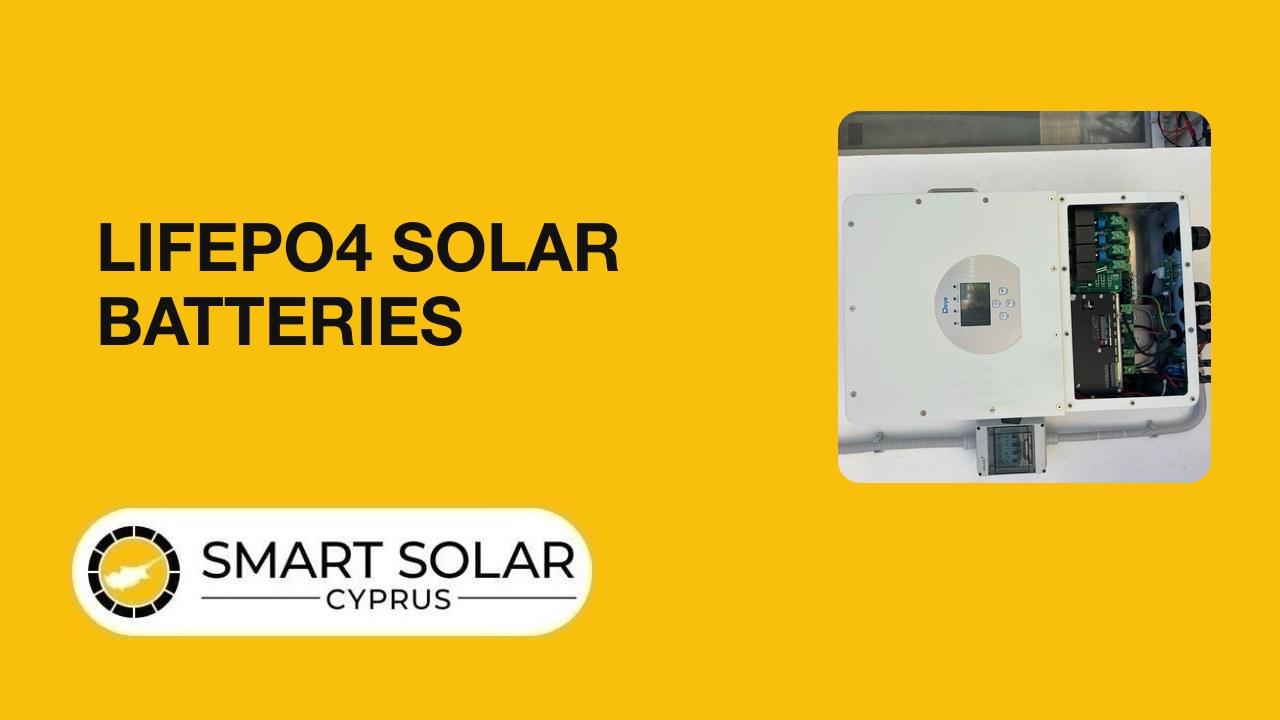
Search for a solar battery in Cyprus and almost every listing says LiFePO4. You see it on a €150 boat battery in a chandlery, on a 15 kWh pack assembled in a Larnaca workshop and on the spec sheet of a Huawei or BYD home battery. The word is the same, but the products are very different.
Since 1 January 2026 new solar systems in Cyprus connect under Net Billing, where exported power earns roughly €0.08–0.10 per kWh and imported power costs around €0.25. Storing your own midday surplus for the evening is now the main way to get value from a system, so a lot of people are shopping for batteries for the first time.
This guide explains what LiFePO4 is, why it suits a hot climate, how to read cycle life and warranty claims, and where the line sits between a DIY pack and a battery you can legally connect to a grid-tied home system.
What LiFePO4 means
LiFePO4 is lithium iron phosphate, usually shortened to LFP. It is one type of lithium-ion battery. The name refers to the cathode material. The other common home battery chemistry is NMC (nickel manganese cobalt), which older home batteries and most electric cars used.
A few facts about LFP that matter in practice:
- Cell voltage: each LFP cell is about 3.2 V nominal. Four in series make a 12.8 V "12 V" battery, sixteen make the 51.2 V packs sold as 48 V home batteries.
- Energy density: LFP stores less energy per kilo than NMC. A 10 kWh LFP home battery typically weighs 100–125 kg, which is fine on a garage wall and irrelevant for a house.
- No cobalt or nickel: the materials are cheaper and less constrained, which is a large part of why LFP prices have fallen.
- Flat voltage curve: the voltage barely changes between 20% and 90% charge, so the battery management system (BMS) has to track state of charge by counting energy in and out rather than reading voltage.
Most of the big home battery brands have moved to LFP. Huawei LUNA2000, BYD Battery-Box, Pylontech and the Tesla Powerwall 3 all use it. When someone says "lithium battery" for solar in 2026, they usually mean LFP.
Why LFP suits Cyprus heat
Heat is the main thing that shortens battery life in Cyprus. A garage in Paphos or Nicosia can sit above 35°C for weeks in July and August, and a battery in direct sun or in a metal shed can go well past that.
LFP handles this better than NMC for two reasons:
- Thermal stability: the phosphate cathode holds on to its oxygen at much higher temperatures, so LFP cells are far less prone to thermal runaway. That is the main safety argument for LFP in homes.
- Slower ageing in heat: all lithium batteries age faster when hot, but LFP loses capacity more slowly than NMC at the same temperature.
That does not mean you can put one anywhere. Most LFP home batteries charge within roughly 0–50°C and last longest between 15°C and 30°C. In practice we follow a few rules on every install:
- Shade first: an inside wall of a garage, utility room or covered parking. Never a wall that gets afternoon sun.
- Airflow: leave the clearances in the manual. Batteries and hybrid inverters both give off heat, and a closed cupboard traps it.
- Mountain homes: in Troodos villages the issue flips in winter. LFP must not be charged below 0°C, so a battery in an unheated outbuilding may need a model with built-in heating or a warmer location.
Cycle life and warranties: reading the numbers
Spec sheets for LFP batteries quote 6,000 cycles or more, sometimes 8,000. A cycle is one full charge and discharge. A typical Cyprus home battery does close to one cycle a day for most of the year, so 6,000 cycles is around 15 years of use on paper.
The numbers come with conditions that are worth reading:
- Depth of discharge: cycle ratings are usually quoted at 80–90% depth of discharge. Running the battery from 100% to 0% every day wears it faster.
- End-of-life definition: "6,000 cycles" normally means the battery still holds 70–80% of its original capacity at that point, not that it stops working.
- Temperature: ratings are tested at around 25°C. A battery that lives at 35°C will age faster than the sheet suggests.
The warranty matters more than the cycle number because it is what the manufacturer will actually stand behind. Home batteries from established brands usually carry 10 years, with a guaranteed minimum capacity (often 60–70%) and sometimes a cap on total energy throughput in MWh. If you hit the throughput cap before 10 years, the warranty ends early. Ask for the warranty document, not just the brochure.
In our own service work, well-installed lithium batteries are typically holding around 85% of their capacity after eight or more years.
12 V packs vs certified home batteries
This is where most of the confusion comes from. Searching "LiFePO4 battery Cyprus" brings up two separate markets.
Loose 12 V, 24 V and DIY 48 V packs. These are sold for boats, caravans, off-grid cabins and hobby projects, from around €150 for a 12 V 100 Ah unit. Some local sellers assemble 48 V packs from raw cells and a BMS. They can be good value for an off-grid shed or a caravan.
Certified home batteries. These are designed for a specific hybrid inverter, talk to it over a data link (CAN or RS485), and are tested as a system. They are what we fit on grid-connected homes.
For a grid-connected house, the difference matters:
- Compatibility: a hybrid inverter needs to read the battery's state of charge, temperature and current limits from its BMS. An unlisted battery may not communicate, so the inverter either refuses it or runs it blind.
- Connection approval: a grid-connected system goes through the EAC connection process, and the inverter has to meet the grid-protection requirements. Mixing in components the inverter manufacturer does not support can cause problems at inspection and with the inverter warranty.
- Insurance and safety: a home battery holds a lot of energy. Certified products come with fire-safety testing and a manufacturer who answers for them. A self-assembled pack usually does not.
If you are building an off-grid system for a remote property, a well-built 48 V LFP bank can be a sensible choice. For a house on the grid, use a battery the inverter maker lists as compatible.
What an LFP home battery costs in Cyprus
Installed prices for LFP home batteries in Cyprus currently run at about €800–1,000 per kWh of usable capacity, including the battery, integration with the inverter, cabling, protection and commissioning. As a guide:
- 5 kWh: around €4,000–5,000 installed. Covers evening lighting, fridge, TV and some air conditioning in a small household.
- 10 kWh: around €8,000–10,000 installed. The most common size for a three-bedroom home with a 5–6 kW system.
- 15–20 kWh: larger homes, pools, or households that run several air conditioners after sunset.
If you already have a solar system with a string inverter, adding a battery may mean swapping to a hybrid inverter or adding an AC-coupled battery. That changes the price, so get it checked before you budget. Our solar battery storage packages list current sizes, and the savings calculator gives a first estimate of what your system would produce.
There is currently no battery subsidy open in Cyprus. We track the battery subsidy situation and update that page when a scheme opens.
How to compare LFP batteries
When you have two or three quotes in front of you, these are the points worth comparing:
- Usable capacity, not nominal: some sellers quote the total cell capacity. Ask for usable kWh.
- Inverter compatibility: confirm the battery is on the inverter maker's compatibility list. Our guide to choosing a solar inverter covers hybrid models.
- Warranty terms: years, guaranteed end capacity and any throughput cap.
- Continuous power output: a battery with 10 kWh of capacity but only 3 kW of output cannot run two air conditioners and an oven at once.
- Backup capability: if you want power during outages, check that the inverter and battery support backup or a separate backup box. Our article on whether solar works in a power cut explains the options.
- Expandability: modular batteries let you start with 5 kWh and add modules later.
- Local service: who comes out if the BMS throws a fault in year six?
If you are still deciding whether storage makes sense at all, start with do you need a battery for solar panels in Cyprus. For sizing and payback detail, see our battery storage guide.
When you are ready, our battery storage service covers survey, sizing and installation, or you can request a quote with a recent EAC bill and we will size a system around your actual usage.
Frequently Asked Questions
Is LiFePO4 better than lithium-ion?
LiFePO4 is a type of lithium-ion battery. Compared with NMC, the other common lithium chemistry, it is heavier for the same capacity but safer, cheaper per kWh and longer-lasting in heat. For a fixed home battery in Cyprus, those trade-offs favour LFP.
How long does a LiFePO4 solar battery last in Cyprus?
A good LFP home battery installed in shade typically lasts 12–15 years or more, and manufacturers usually warrant 10 years with a minimum retained capacity. Batteries kept in hot, sunny locations age faster.
Can I connect a cheap 12 V LiFePO4 battery to my home solar system?
Not to a grid-connected home system. Hybrid inverters for houses work with specific high-voltage or 48 V batteries that communicate with them. Loose 12 V batteries suit boats, caravans and small off-grid setups.
Is LiFePO4 safe to install indoors or in a garage?
LFP is the most thermally stable lithium chemistry used in homes, which is why most manufacturers now use it. Follow the installation manual for clearances and ventilation, keep it out of direct sun and away from living spaces where possible, and use a certified product.
How much does a 10 kWh LiFePO4 battery cost in Cyprus?
Installed with a compatible inverter, expect around €8,000–10,000 for 10 kWh of usable capacity. The exact figure depends on the brand and on whether your existing inverter can take a battery.
Want a quote tailored to your roof and your bill?
A free site visit and proposal, with no obligation and no pressure.
Keep reading
All articles
Plug-in Solar Panels in Cyprus: Are Balcony Kits Allowed?
Can you plug a solar panel into a socket in Cyprus? What the rules say about balcony kits, the safety risks, what they produce and the legal alternatives.
EAC Smart Meters in Cyprus: What Solar Owners Should Know
How to read the EAC smart meter with solar panels: import 1.8.0, export 2.8.0, what changes under net metering and Net Billing, plus the EAC data portal.
Solar Panel Size and Dimensions: A Cyprus Roof Guide
Solar panel dimensions and weights for 2026 modules, how many fit on a Cyprus roof, flat-roof row spacing, and how panel size affects your quote.