
Off-Grid Solar Systems in Cyprus: Costs and Sizing
What a genuine off-grid solar system costs in Cyprus, how to size panels and battery for December, and when a grid connection is still the cheaper answer.
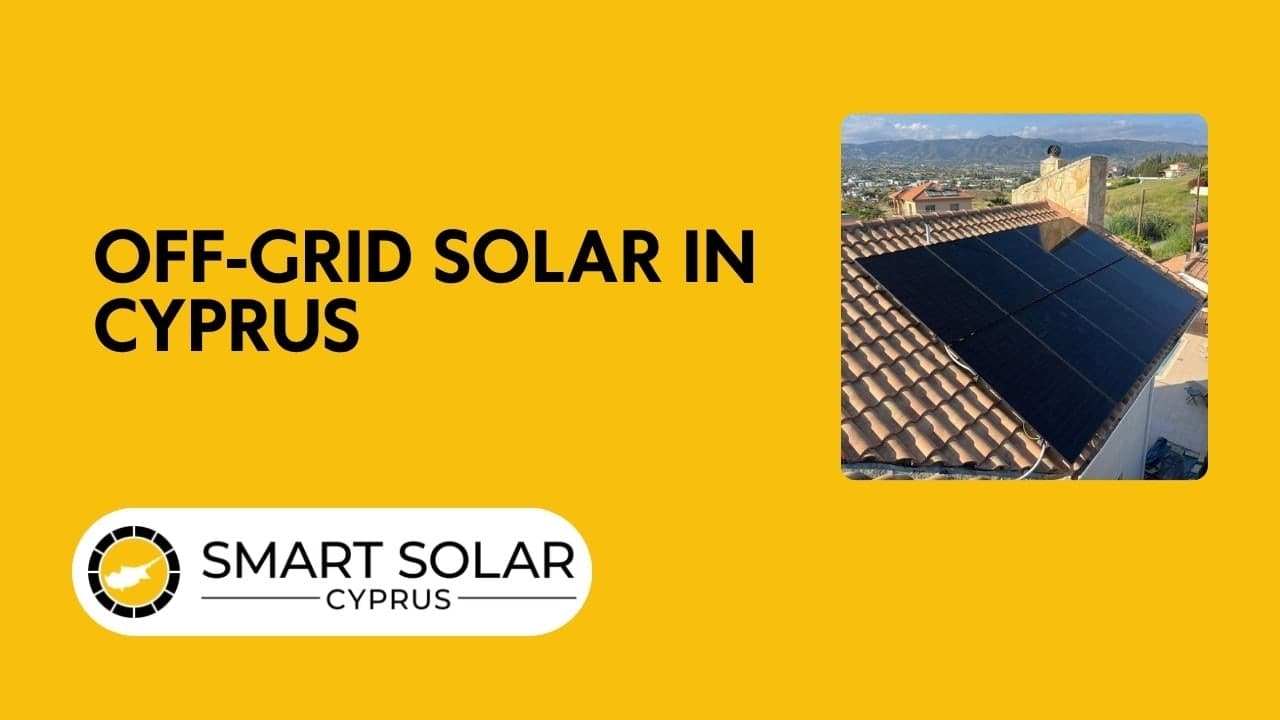
Every few weeks someone calls us about a plot in the hills above Paphos, a stone house in a Troodos village, or a farm building at the end of a long dirt track, and asks the same question: can we just go off-grid instead of paying to bring power in?
Often the answer is yes. Cyprus has the sunshine for it, lithium storage has come down enough to make it practical, and the equipment is no longer exotic. But off-grid is a genuinely different engineering problem from the rooftop systems most people are quoted, and the systems that fail are almost always the ones designed as if it were the same.
The difference comes down to one thing. A grid-tied system uses the grid as an infinite, invisible backup. An off-grid system has no backup at all, so it has to be sized for the worst week of the year rather than the average one.
Off-grid, hybrid and grid-tied are three different systems
These three terms get used interchangeably in quotes, and they should not be. They describe very different builds at very different prices.
Grid-tied
Panels, an inverter, and a connection to the EAC network. Anything you do not use is exported. There is no battery, and the system shuts down in a power cut for the safety of anyone working on the line. This is what most Cyprus homes have, and under Net Billing it is still the cheapest way to cut a bill.
Hybrid
The same grid connection, plus a battery and an inverter that can manage it. You bank surplus generation and spend it in the evening instead of buying it back at retail rates, and most hybrid inverters will run a backup circuit when the grid drops. This is the default recommendation for a connected home now, and our guide to what actually keeps running in a power cut explains how that backup mode works in practice.
Off-grid
No connection at all. The array and the battery bank are the entire electricity supply, every day of the year, including the four grey days in January when the panels produce a fraction of their summer output. Nothing is exported, because there is nowhere to export it to.
The commercial point matters: a hybrid system is a grid-tied system with a battery added. An off-grid system is a standalone power station, and it is priced accordingly.
When off-grid genuinely makes sense in Cyprus
There are three situations where it is clearly the right call.
- The connection cost is prohibitive. A remote plot far from the nearest low-voltage line has to pay for that line to be extended. Get a written connection quote from the distribution operator before anything else — for isolated sites this is frequently the largest single figure in the project, and it is the number that makes or breaks the off-grid case.
- The load is small and seasonal. A field shelter, a stone cabin, an irrigation pump, a workshop used at weekends. Small loads with generous daylight hours are the easiest and cheapest thing to run independently, and the systems are modest.
- A connection is simply not available. Some agricultural buildings and land parcels have no realistic route to a supply. Off-grid is not the cheaper option there; it is the only option.
Where it usually does not make sense is a normal house that already has, or can easily get, a supply. Disconnecting from the grid to run purely on solar means paying for enough battery and enough panels to survive a run of bad weather, and that redundancy costs far more than the standing charges you would save. For a connected property, a hybrid system captures nearly all of the benefit at a fraction of the cost — our battery storage page sets out that comparison.
Size for December, not for August
This is the single principle that separates an off-grid system that works from one that leaves you sitting in the dark in February.
A Cyprus rooftop array produces in the region of 1,700 kWh per installed kWp across a full year, but that output is not spread evenly. Midsummer days deliver several times what a short, overcast December day does, and December is when you are also running lights and heating for longer. Our breakdown of how much electricity solar panels actually produce in Cyprus has the seasonal shape in detail.
A grid-tied system does not care, because the grid smooths it out. An off-grid system has to carry the shortfall itself, which drives three design decisions.
- The array is oversized against summer needs. You size the panels so that a poor winter day still refills the battery. In July that means a system generating far more than the property can use, and the surplus is simply thrown away. That is normal and unavoidable off-grid.
- The battery bank is sized in days of autonomy, not hours. A connected home might fit 10 kWh to shift its evening load. An off-grid home wants enough to run for one to two full days with almost no sun, which typically means two to three times as much storage for the same household.
- There is usually a generator. Not to run the house, but to cover the handful of days a year when a long cloudy stretch outlasts the battery. Sizing an array to survive every possible weather event is far more expensive than sizing it sensibly and accepting perhaps 20 hours of generator time a year.
Work out your daily consumption in kWh first, from bills if you have them or from an appliance-by-appliance estimate if the property is new. Everything else follows from that number, and getting it wrong is the most common and most expensive mistake in off-grid design.
What an off-grid system costs in Cyprus
These are indicative installed ranges for properly engineered systems using lithium iron phosphate storage. The battery is the dominant cost, so the numbers scale with consumption rather than with roof area.
- Cabin or seasonal use — €6,000 to €12,000: roughly 1.5 to 3 kWp of panels with 5 to 10 kWh of storage. Lighting, a fridge, a pump, phone and laptop charging, occasional small tools. Adequate for weekends and summer living, tight in midwinter.
- Small permanent home — €16,000 to €24,000: roughly 4 to 6 kWp with 15 to 20 kWh of storage. A modest full-time household with an efficient fridge, washing machine, television and lighting, using bottled gas or wood for cooking and heat.
- Full family home — €28,000 to €40,000 and upwards: roughly 8 to 10 kWp with 25 to 30 kWh of storage. Once you add air conditioning, an electric oven, a water heater or an electric car, the figures move quickly, and a generator becomes close to essential.
For comparison, a grid-tied 5 kW system on a connected house typically lands between €6,500 and €7,500 — see our 2026 price guide for the full breakdown. The difference is not markup; it is the battery bank and the redundancy that replace the grid.
Two things push a quote up sharply: air conditioning, because it runs hardest exactly when you most want to bank charge, and electric water heating, which is far better served by a solar thermal cylinder or a heat pump than by an off-grid battery.
The components that differ
An off-grid build is not a rooftop system with a battery bolted on. Several parts are specified differently.
- The inverter must be able to form its own grid. A standard grid-tied inverter needs an existing AC signal to synchronise with and will not start without one. Off-grid and capable hybrid units create the AC waveform themselves, and must be rated for your largest surge load — a borehole pump or a compressor starting can draw several times its running current. Our guide to choosing a solar inverter covers the types in more depth.
- The battery is a bank, not an accessory. Lithium iron phosphate is the standard, typically rated beyond 6,000 cycles, with a battery management system that talks to the inverter. Mixing chemistries or adding mismatched modules years later is where retrofits go wrong.
- Everything sits in a controlled environment. Batteries and inverters lose capacity and life in sustained heat, which is a real constraint in a Cyprus summer. A ventilated, shaded plant room is part of the design, not an afterthought.
- Monitoring is not optional. With no grid behind you, a fault you cannot see is a fault you find out about when the lights go off. Remote monitoring and a service plan matter more here than on any other kind of system — which is why we bundle it with maintenance and monitoring on every off-grid install.
The problems that actually occur
In the field, off-grid systems fail for a short and repetitive list of reasons.
Consumption was underestimated at the design stage. Someone guesses 8 kWh a day and the real figure is 14. The battery hits its limits every winter evening and the generator runs constantly. This is by far the most common failure, and it is a survey problem, not an equipment problem.
The array is too small relative to the battery. A big battery that cannot be refilled on a short winter day is expensive dead weight. Panels are the cheapest component in the system; be generous with them.
Surge loads were not accounted for. The inverter handles the household fine until the water pump and the washing machine start together, and then it trips.
No one changed how they use power. Off-grid living works best when the heavy loads — washing, pumping, charging — run in the middle of the day while the sun is doing the work. Households that shift their routine barely notice the constraint; households that do not, run the generator.
Already connected to the grid? Read this first
If the property has a supply, going fully off-grid is almost never the rational choice in Cyprus, and we will tell you so before quoting.
Since Net Billing replaced net metering for all new connections in January 2026, exported electricity earns roughly €0.08 to €0.10 per kWh against a retail price of about €0.25 to €0.30. That shift has made self-consumption and storage far more valuable than they were — but it is an argument for a hybrid system, not for cutting the wire. A hybrid gives you the evening savings, the blackout protection and the independence that people actually want, while the grid quietly handles the bad week in January that would otherwise cost you five figures in extra battery capacity.
Keeping the connection also keeps your options open: an electric car, a heat pump, or a future battery subsidy are all far easier to absorb with a supply behind you.
What we look at before quoting
An honest off-grid quote is not possible from a phone call. Before we put numbers on paper we want your daily and seasonal consumption in kWh, an inventory of the heavy and surge loads, the written connection quote if a supply is even theoretically possible, the site's shading and orientation, and somewhere sensible to house the battery and inverter.
If you are weighing a remote property against a connected one, our off-grid and hybrid systems page shows the kind of builds we do, and a free site assessment gets you a designed system with the components named and the winter case checked, rather than a package price.
Frequently Asked Questions
How much does an off-grid solar system cost in Cyprus?
Indicatively, €6,000 to €12,000 for a cabin or seasonal property, €16,000 to €24,000 for a small permanent home, and €28,000 to €40,000 or more for a full family house with air conditioning. The battery bank is the largest line in every one of those figures, so the cost tracks your consumption far more closely than your roof size.
Can I run a whole house off-grid in Cyprus?
Yes, and plenty of properties do. The requirement is honest sizing: enough panels to refill the battery on a poor December day, enough storage for one to two days without sun, an inverter rated for your surge loads, and usually a small generator for the few worst days a year. Air conditioning and electric water heating are what make it expensive.
Is off-grid cheaper than connecting to the EAC grid?
Only when the connection itself is expensive. For a remote plot needing a line extension, off-grid frequently wins outright. For a property that already has a supply, or one metres from an existing line, a grid-tied or hybrid system is considerably cheaper and more flexible.
What are the common problems with off-grid solar?
Underestimated consumption at the design stage, an array too small to recharge the battery in winter, an inverter that cannot handle pump or compressor start-up, and heat shortening battery life in a poorly ventilated plant room. All four are design and survey failures rather than equipment faults.
Do I still need a generator with an off-grid system?
Usually yes, as insurance rather than as a power source. Sizing an array and battery to survive every conceivable run of cloudy weather costs far more than accepting a modest amount of generator time in a bad winter. A well-designed Cyprus system should need it rarely.
Can I convert my existing solar system to off-grid?
Sometimes, but rarely cheaply. The panels usually carry over; the inverter typically does not, since a grid-tied unit cannot form its own AC supply, and you are adding a full battery bank on top. If the goal is independence during outages rather than leaving the grid, a hybrid retrofit reaches it for much less — our battery storage guide covers what that involves.
Want a quote tailored to your roof and your bill?
A free site visit and proposal, with no obligation and no pressure.
Keep reading
All articles
Virtual Net Billing in Cyprus: Solar Without a Roof
How virtual net billing in Cyprus works: panels on one site credit the EAC bill of another. Who it suits, the 400 kWp limit, real returns and the process.
How to Read Your EAC Bill With Solar Panels in Cyprus
Your EAC bill with solar panels, line by line: import and export readings, net metering credits, Net Billing euro credits, and why the bill can still rise.
Heat Pump With Solar Panels in Cyprus: 2026 Guide
Running a heat pump on solar in Cyprus: running costs, how much PV it needs in winter, what installation costs and how Net Billing changes the sums.