
Solar Inverters in Cyprus: How to Choose in 2026
How to choose a solar inverter in Cyprus: hybrid vs string vs microinverters, sizing, heat, brands and costs — and why hybrid now wins under Net Billing.
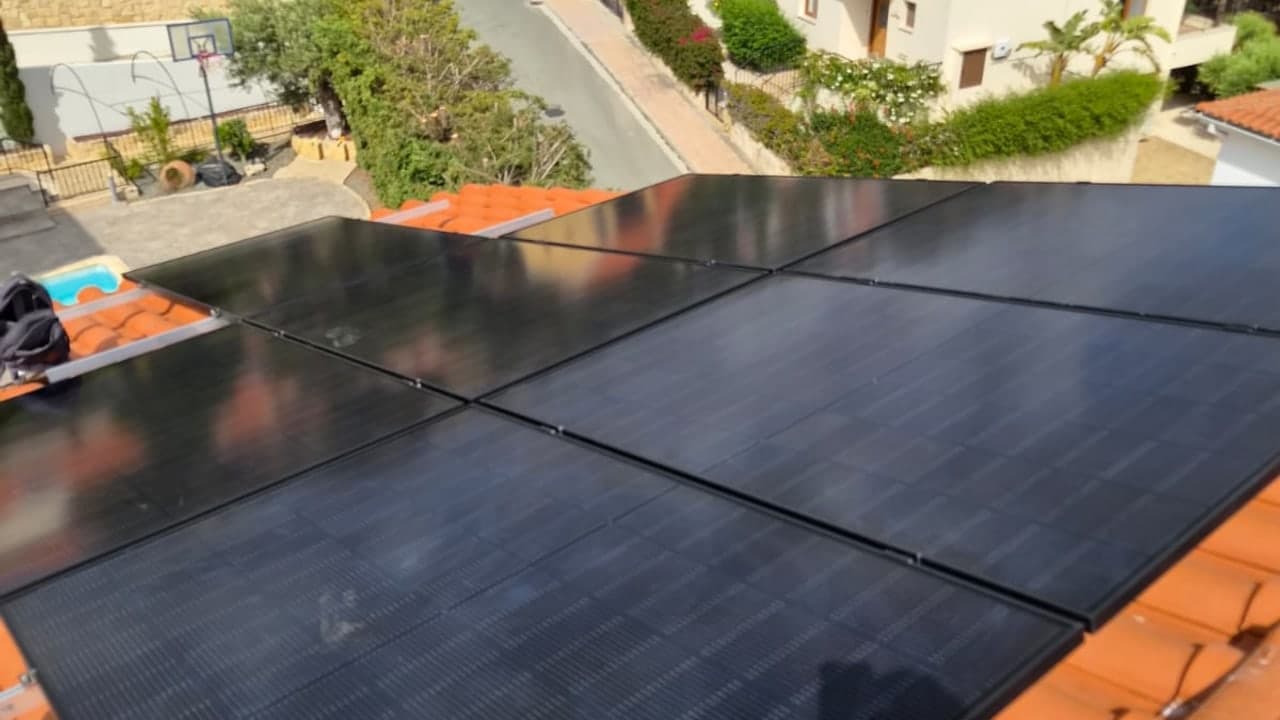
Most people choosing a solar system in Cyprus spend their time comparing panels. Which brand, how many watts, monocrystalline or bifacial. Then they sign a quote without ever asking which inverter is in it.
That is the wrong way round. Panels are commodities now — reliable, warrantied for decades, and broadly similar between reputable manufacturers. The inverter is the component that decides how much of your generation you actually keep, whether you can add a battery later, whether the lights stay on in a power cut, and it is very often the first part of the system to fail.
Under Net Billing it matters more than it used to. When exported electricity earns roughly a third of what imported electricity costs, the equipment that controls where your power goes stops being a technical footnote and becomes the thing your payback rests on.
What the inverter actually does
Solar panels produce direct current. Your home, and the grid it connects to, run on alternating current. The inverter sits between them and converts one into the other.
That conversion is the headline job, but a modern inverter does considerably more. It tracks the point on each string of panels where power output peaks, and holds them there as light and temperature shift through the day. It monitors grid voltage and frequency, and disconnects safely if either drifts outside limits. It logs production so you can see what the system is doing. And in a hybrid unit, it decides — second by second — whether each kilowatt goes to the house, the battery or the grid.
For the wider picture of how these parts fit together, our guide to how photovoltaic systems work walks through the full chain from panel to meter.
The three types you will be quoted
Almost every residential quote in Cyprus contains one of three architectures.
String inverters
A single box, usually mounted on a wall near your meter, with all the panels wired to it in one or two series strings. It is the simplest, cheapest and most common arrangement, and for an unshaded Cyprus roof with a single orientation it works extremely well.
The limitation is that panels in a string behave somewhat like a group moving at the pace of its slowest member. Shade one panel and you drag on the whole string. On a clean, south-facing roof that rarely matters. On a roof broken up by chimneys, solar water heaters or a neighbour's palm tree, it does.
Hybrid inverters
A hybrid is a string inverter with battery management built in. It handles the panels, charges and discharges a DC-coupled battery, and in most models can run a backup circuit when the grid drops.
This is now the default recommendation for most Cyprus homes, and the reasoning is set out below. The important practical point is that a hybrid does not oblige you to buy a battery on day one — it means you can add one later without replacing the most expensive electronic component in the system.
Microinverters and power optimisers
Instead of one inverter for the whole array, these put a small device behind each panel, so every module produces independently. Shade on one panel costs you that panel and nothing else, and you get per-panel monitoring.
The trade-off is cost and count. You are buying and installing a dozen or more electronic devices, mounted on a roof that reaches serious temperatures in July, rather than one unit in a shaded, ventilated position. In Cyprus, where roofs are large, unshaded and reliably sunny, the shading advantage often does not justify the premium. Where it earns its keep is on a genuinely awkward roof: multiple pitches, several orientations, or shading you cannot design out.
Why hybrid inverters now dominate Cyprus quotes
Under net metering, the grid effectively stored your surplus at full value, so a plain string inverter was usually the rational choice. Since Net Billing took over for all new connections in January 2026, the arithmetic has inverted.
Electricity you consume in the house the moment it is generated saves you the full retail rate, roughly €0.25 to €0.30 per kWh. Electricity you export earns the wholesale rate instead, around €0.08 to €0.10 per kWh. Our explainer on how net billing works in Cyprus covers the mechanics in full.
Every kilowatt-hour you can shift from export to self-consumption is therefore worth roughly three times as much. That is exactly what a battery does, and a hybrid inverter is what allows you to add one.
The cost of keeping that door open is modest. A hybrid typically adds somewhere in the region of €500 to €1,000 over an equivalent string inverter. Retrofitting storage onto a system built around a plain string inverter usually means either replacing that inverter or bolting on a separate AC-coupled battery inverter — both of which cost considerably more than the original upgrade would have. If there is any chance of storage in your future, specify the hybrid now. Our battery storage page covers sizing and payback, and do you need a battery in Cyprus takes the honest view of when it does not pay.
Sizing: why the inverter is smaller than the array
Newcomers are often surprised to see a 5 kW inverter quoted for a 6 kW array and assume it is a mistake. It is not.
Panels almost never produce their rated output. That figure comes from laboratory test conditions at 25°C, and a Cyprus rooftop in August is nowhere near that. Real-world peaks land meaningfully below nameplate, so deliberately fitting an inverter smaller than the array — commonly at a DC-to-AC ratio of about 1.1 to 1.3 — keeps the unit working in its efficient band for far more of the year, at lower cost.
The occasional loss is called clipping: on a handful of perfect spring days the array briefly makes more than the inverter can pass, and the excess is trimmed. Across a year that typically costs a low single-digit percentage of production, and under Net Billing those clipped kilowatt-hours would mostly have been exported at the low rate anyway.
Two cautions. Push the ratio much beyond 1.3 and clipping stops being trivial. And if you expect to expand the array later, size the inverter with that headroom now — see what size solar system you need in Cyprus for how the array itself should be sized.
Single-phase or three-phase
Your electricity supply decides part of this for you. Homes on a single-phase supply take a single-phase inverter and face a cap on connected PV capacity — the figure commonly applied in Cyprus is around 4.16 kWp, which is why so many residential quotes cluster just below it. Three-phase properties can connect substantially more and should use a three-phase inverter, which also spreads the load evenly across the phases.
Confirm which supply your property has before comparing quotes. It frequently settles the inverter question before any brand discussion starts, and it is one of the checks we run as part of every full photovoltaic system we install.
Heat: the Cyprus-specific factor
This is where local experience separates good installations from ones that disappoint in year three.
Inverters are electronics, and electronics dislike heat. Every unit derates — deliberately reduces output — above a certain internal temperature, and sustained heat shortens component life, particularly the capacitors. A Cyprus summer subjects them to conditions most European installation manuals were not written around.
What follows is practical:
- Mount it out of direct sun. A north-facing wall, a shaded utility area or a garage is worth far more than a marginal efficiency figure on a datasheet. An inverter baking on a south wall all afternoon will derate when your array is at full output — precisely the worst moment.
- Leave the clearances. Manufacturers specify space around the unit for airflow. Boxing an inverter into a tight cupboard is a common and avoidable error.
- Check the temperature ratings, not just efficiency. Look at the derating threshold and the ambient range. A unit that holds full output to a higher temperature is genuinely better here, whatever the headline efficiency says.
- Avoid the roof where you can. This is the quiet argument against microinverters in Cyprus: they live in the hottest, least accessible place on the property, and replacing one means going back up.
Brands, costs and what a quote should show
The brands you will encounter most often on Cyprus quotes are Huawei, Sunsynk, Deye, Fronius and SolarEdge. All are credible; they differ in price, battery compatibility, monitoring quality and — the one homeowners never think about until they need it — how quickly a replacement can be sourced locally.
That last point deserves weight. An inverter fault with a supplier who stocks the unit in Cyprus means days out of action. The same fault with a brand that has no local presence can mean weeks of buying every kilowatt-hour from the EAC while you wait.
As indicative equipment-only figures for a typical residential system, a string inverter around 5 kW generally sits in the €700 to €1,400 range, with a comparable hybrid roughly €1,300 to €2,400. Microinverter and optimiser systems price per panel and usually land above both. These are guides rather than promises — most quotes bundle the inverter into an installed system price, which is why the 2026 cost guide is a better reference for what you will actually pay.
Insist that any quote names the make and model of the inverter, not just "5 kW inverter". Without it you cannot compare two quotes, check the warranty, or confirm the battery compatibility you may want to use in three years.
Warranties and lifespan
Panels are typically warrantied for performance over 25 years or more. Inverters are not, and this is the single most useful thing to understand about them.
A standard inverter warranty runs 5 to 10 years, with extensions available from most manufacturers. Real-world service life commonly lands in the 10 to 15 year range, better if the unit is mounted somewhere cool and sensible. Plan on the assumption that you will replace the inverter at least once during the life of the panels, and budget accordingly rather than treating it as a failure when it happens.
Monitoring is worth checking too. A good platform shows per-string production, flags faults early and lets your installer diagnose remotely, which frequently turns a site visit into a phone call. It is a core part of our maintenance and monitoring service, and the reason many faults get caught before the homeowner notices a change in the bill.
If you are considering genuine off-grid or backup capability rather than simple grid-tied solar, the requirements shift again — our off-grid and hybrid systems page sets out what changes.
Getting it specified properly
The right inverter is not the most expensive one on the market. It is the one matched to your supply, your roof, your consumption pattern and whatever you might reasonably add in the next decade — installed somewhere it will not cook.
If you want that specified against your own roof and bills rather than a generic package, a free site assessment produces a system design with the inverter named, sized and justified before you commit to anything.
Frequently Asked Questions
What is the best solar inverter for Cyprus?
There is no single best model, but for most Cyprus homes the best type is a hybrid inverter from a brand with genuine local support and stock. It keeps the battery option open under Net Billing, where self-consumption is worth roughly three times export. Prioritise strong high-temperature performance and a supplier who can replace the unit quickly.
How much does a solar inverter cost in Cyprus?
As an indicative equipment-only range, a 5 kW string inverter typically falls between €700 and €1,400, and a comparable hybrid between €1,300 and €2,400. Most installers quote an installed system price rather than itemising the inverter, so ask for the make and model to compare quotes meaningfully.
How long do solar inverters last?
Usually 10 to 15 years, with warranties commonly running 5 to 10 years and extensions available. That is materially shorter than the panels, so expect one replacement over the system's life. Mounting the unit out of direct sun with proper ventilation is the single biggest thing you can do to reach the upper end of that range.
Do I need a hybrid inverter if I am not buying a battery?
Not strictly, but it is usually the cheaper decision over time. A hybrid adds roughly €500 to €1,000 up front, while retrofitting storage to a plain string inverter later means replacing it or adding a second battery inverter — typically a larger bill than the original upgrade.
Can I add a battery to my existing solar system in Cyprus?
Yes. If you already have a hybrid inverter with spare capacity, it is straightforward. If you have a standard string inverter, you either replace it with a hybrid or add an AC-coupled battery inverter alongside it. Both work; both cost more than specifying a hybrid at the outset.
Where should the inverter be installed?
Somewhere shaded, ventilated and accessible — a north-facing wall, a covered utility area or a garage. Direct summer sun causes the unit to derate exactly when your array is producing most, and sustained heat shortens its life. Keep the manufacturer's clearances around it, and avoid enclosed cupboards.
Want a quote tailored to your roof and your bill?
A free site visit and proposal, with no obligation and no pressure.
Keep reading
All articles
Which Way Should Solar Panels Face in Cyprus?
The best direction and tilt angle for solar panels in Cyprus: why due south is not always the right answer under Net Billing, and what flat roofs need.

Solar Air Conditioning in Cyprus: What Actually Works
How to run air conditioning on solar in Cyprus: how many panels one aircon needs, whether DC solar air conditioners are worth it, and what it costs.
Solar Battery Subsidy in Cyprus: What's Coming in 2026
Cyprus has promised a home battery subsidy but nothing has opened. What has been said, what the September grant covers, and how to be ready on day one.