
How Do Photovoltaic Systems Work? A Cyprus Homeowner's Guide
How rooftop photovoltaic systems convert Cyprus sunshine into electricity. Panels, inverters, the grid, and what each part actually does for your bill.
Updated July 2026 to reflect the Net Billing rules that now apply to every new system.
A kilowatt of well-placed solar panels in Cyprus returns around 1,600-1,700 kilowatt-hours a year, which is why the same hardware pays back years faster here than in most of Europe. But between sunlight landing on your roof and a lower EAC bill sits a chain of equipment doing quiet, precise work.
This guide follows that chain end to end: how the panels make electricity, what the inverter and the rest of the system do, and what happens to every kilowatt-hour you produce under the 2026 rules.
The physics, in one paragraph
Sunlight is a stream of photons. When photons strike the silicon cells in a panel, they transfer energy to electrons and knock them loose, and moving electrons are, by definition, an electric current. Each cell contributes a small voltage; wired together in a panel, and panels wired together in strings, they deliver useful direct current whenever light falls on them. No moving parts, no fuel, no noise: the same physics that powers a calculator, scaled up to run a house.
Two consequences of "light, not heat" surprise people. First, panels work on cloudy days, at roughly 10-25% of peak output. Second, panels are actually more efficient in cooler weather: a bright March afternoon beats a 40°C August one per unit of light, which is one reason Cyprus winter production stays worthwhile.
Kilowatts and kilowatt-hours, untangled
System sizes are quoted in kilowatts (kW): the maximum power the array delivers in strong sun. Your bill is measured in kilowatt-hours (kWh): energy, or power sustained over time. A "5 kW system" means the panels can peak around 5 kW; across a Cyprus year it translates into roughly 8,500 kWh of energy.
That one conversion, about 1,700 hours' worth of full-power output per year, is the number that makes Cyprus solar exceptional. The same system in central Europe manages closer to 1,000. Our production guide breaks the figures down month by month.
The five components that turn light into savings
Panels
Modern residential panels produce 400-600 W each and convert 20-22% of incoming light into electricity. For Cyprus conditions, the details that matter are the temperature coefficient (how gracefully output declines in summer heat), the 25-year performance warranty (quality panels still deliver around 85% of rated output at year 25), and build quality against dust and coastal humidity. On flat, light-coloured roofs, bifacial panels add a further margin by harvesting light reflected onto their rear face; on typical tiled pitches the gain is smaller.
The inverter
Panels produce DC; your home and the grid run on AC. The inverter converts between them at 97-99% efficiency and manages the system's interaction with the grid. It is the component with the hardest job and the shortest warranty (typically 10-12 years), which is why we fit units from manufacturers with authorised support in Cyprus, such as Fronius, SMA and Huawei. A hybrid inverter also manages a battery, and in 2026 it is the default choice: it makes the system storage-ready even if the battery comes later. Micro-inverters or optimisers, which manage panels individually, earn their extra cost on roofs with partial shade.
Mounting
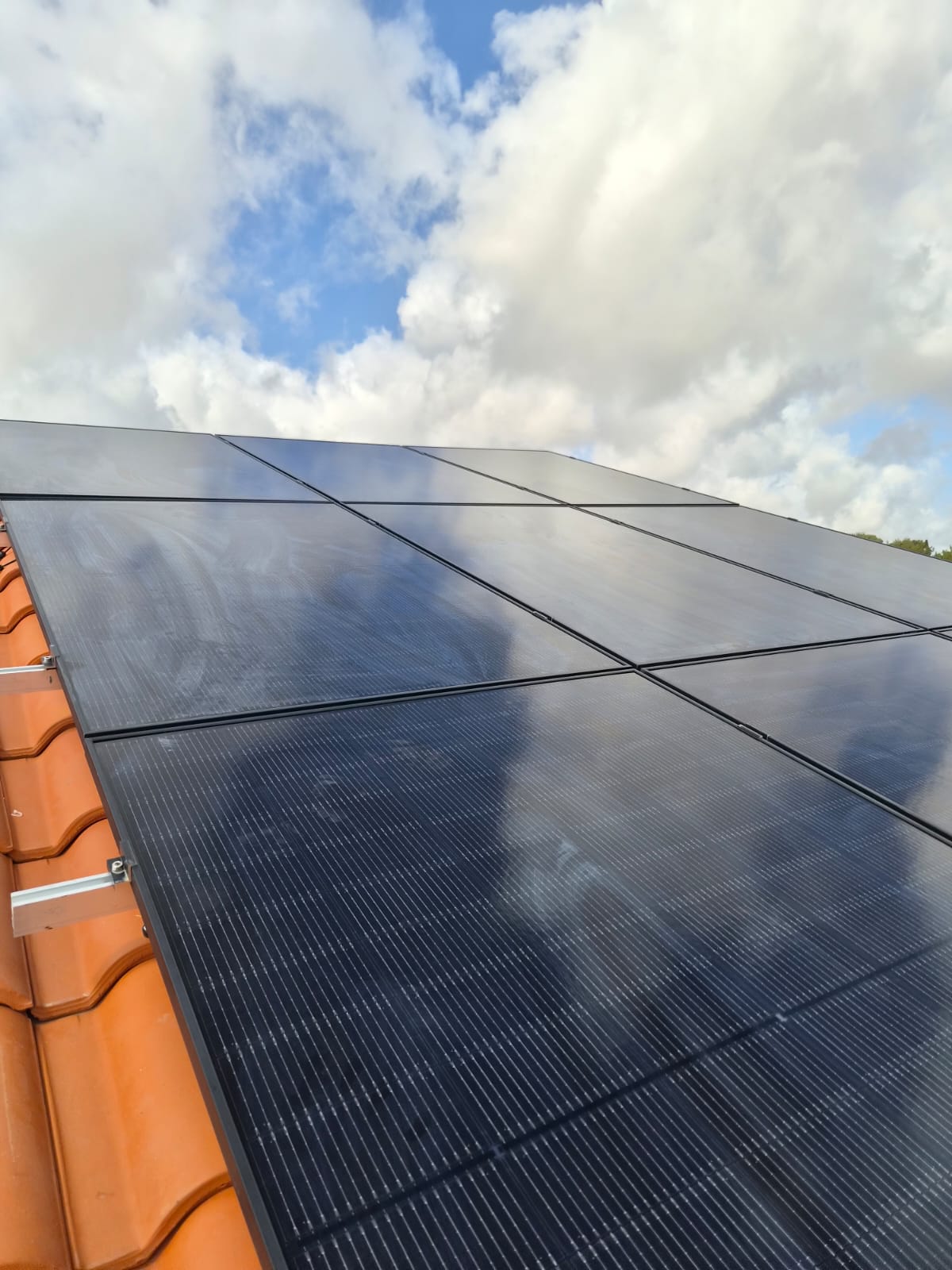
Cyprus sits at 35° latitude, and panels here perform best tilted around 25-35 degrees towards the south. On tiled roofs, anchored rails follow the pitch; on the island's many flat roofs, aluminium frames set the ideal angle and orientation. Mounting is also the component that fights the wind: frames and fixings are sized for gust loads, and every roof penetration is waterproofed.
Monitoring
Every system we install includes app-based monitoring showing production, consumption and, with a battery, state of charge, in real time. Monitoring is not a gadget; it is how you learn to shift usage into production hours, and how a failing string or a dusty array announces itself as a dip on a chart rather than a surprise on a bill.
Protection
DC isolators allow safe shutdown, surge arrestors defend against summer lightning storms, and anti-islanding protection disconnects the system automatically during a grid outage so EAC line workers are never fed by your roof. That last one means a standard grid-tied system goes dark in a power cut; backup through outages requires a battery system designed for it.
Follow one kilowatt-hour: the 2026 rules
Since 1 January 2026, every new system connects under Net Billing, and each kilowatt-hour your roof produces meets one of three fates:
- Used immediately. It powers whatever is running: air conditioning, the washing machine, the water heater. Value: the full retail price you did not pay, roughly €0.30.
- Stored. A battery banks it for the evening. Value: the same €0.30, minus small round-trip losses, delivered after sunset.
- Exported. It flows to the grid for a credit at roughly the wholesale rate, €0.08-0.10.
The gap between fate 1 and fate 3 is the entire strategy of modern Cyprus system design. Run daytime loads on your own production, store the surplus if your evening usage justifies a battery, and export only what remains. Designed this way, systems still reach payback in a few years; our Net Billing explainer walks through the maths, and our Net Billing service page covers the EAC paperwork we handle.
What real Cyprus rooftops produce
Numbers from monitored installations across the island, for a typical 5 kW home system:
- Annual production: around 8,500 kWh
- Daily average: 22-23 kWh across the year
- Peak summer days: 35-38 kWh
- Midwinter days: 12-15 kWh
A 10 kW villa system roughly doubles those figures. Orientation, pitch and shading move the totals, which is why a proper survey models your specific roof rather than quoting island averages.
Installation day, hour by hour
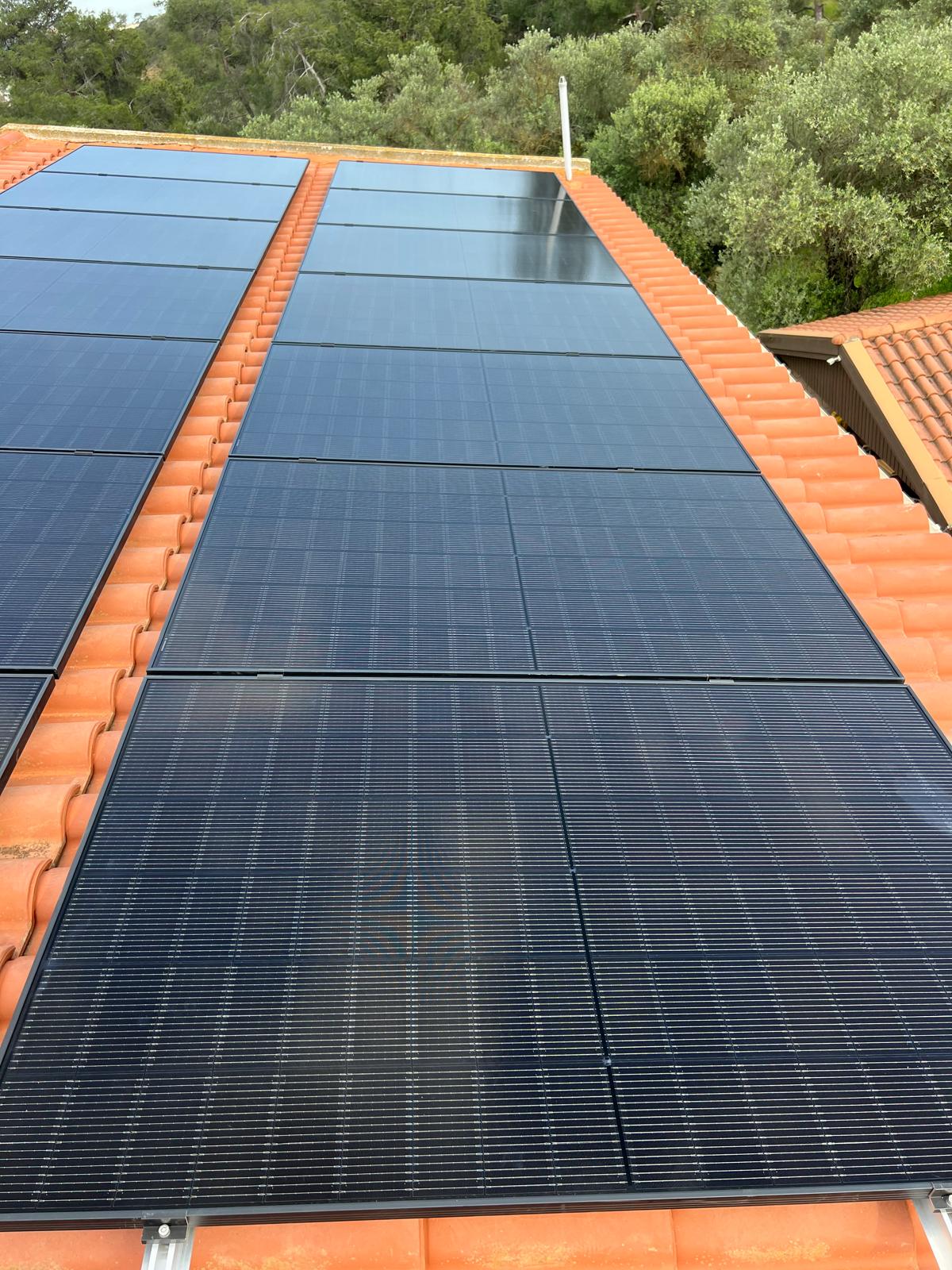
For a typical home system, the physical work fits in one to two days. The crew starts with the mounting: rails anchored and waterproofed on tiled roofs, or ballasted frames positioned on flat ones. Panels follow, then the DC wiring down the prepared route to the inverter. The afternoon goes to the AC side: switchboard connection, protection devices, earthing, and commissioning tests against grid requirements. Before leaving, the installer sets up your monitoring app and walks you through it.
Grid approval is the longer thread: the EAC application, technical drawings and inspection sit around the installation itself, which is why most projects run a few weeks from survey to switch-on even though the roof work takes days.
Living with the system
There is very little to do. Cyprus dust and the occasional Saharan event mean panels benefit from a rinse a couple of times a year, and an annual professional check confirms the electrical side stays tight; our maintenance guide covers the routine. Panels carry 25-year performance warranties and inverters 10-12 years, so budget for one inverter replacement across the system's life.
The economics are covered in depth in our 2026 price guide: turnkey systems from about €4,800, savings of €1,500-3,300 a year at current electricity prices, payback in around three years when the system is designed for self-consumption.
Frequently Asked Questions
How do solar panels work, in simple terms?
Sunlight is made of photons. When they hit the silicon cells in a panel, they knock electrons loose, and those moving electrons are an electric current. The panels produce direct current (DC), an inverter converts it to the alternating current (AC) your home uses, and your appliances draw on it exactly as they would from the grid.
Do photovoltaic panels work at night or during power cuts?
Not at night: no light, no current, so after sunset your home draws from a battery if you have one, otherwise from the grid. During a power cut, a standard grid-tied system also shuts down automatically for the safety of EAC line workers. If you want power through outages, you need a battery system with a backup function that isolates your home from the grid before re-energising selected circuits.
How many solar panels does a typical Cyprus home need?
A 5 kW system, which suits many Cyprus households, uses roughly 11-12 modern 450 W panels and needs about 23-25 square metres of unshaded roof. Smaller homes run well on 3-4 kW, while villas with pools and EV charging often go to 7 kW or more.
What happens to excess electricity my panels produce?
Under the Net Billing scheme that applies to all new Cyprus systems since January 2026, surplus you export to the grid earns a credit at roughly the wholesale rate of €0.08-0.10 per kWh, while evening imports cost the full retail rate of around €0.30. That is why well-designed systems prioritise self-consumption and, increasingly, store the surplus in a battery instead of exporting it.
Do solar panels work on cloudy days in Cyprus?
Yes. Panels respond to light rather than heat, so an overcast day still produces roughly 10-25% of peak output. Cyprus's winters are bright and mild, and cooler temperatures actually improve panel efficiency, so winter days remain genuinely productive.
Next step: a free roof assessment models your actual roof, orientation and consumption, and shows what your specific house would produce. Or start with the calculator for an instant estimate.
Want a quote tailored to your roof and your bill?
A free site visit and proposal, with no obligation and no pressure.
Keep reading
All articles
How to Read Your EAC Bill With Solar Panels in Cyprus
Your EAC bill with solar panels, line by line: import and export readings, net metering credits, Net Billing euro credits, and why the bill can still rise.
Heat Pump With Solar Panels in Cyprus: 2026 Guide
Running a heat pump on solar in Cyprus: running costs, how much PV it needs in winter, what installation costs and how Net Billing changes the sums.
Solar Water Heating in Cyprus: Thermal vs PV in 2026
Your solar water heater's electric element versus heating water with surplus photovoltaic power. What each costs in Cyprus and which wins in 2026.