
Solar Battery Subsidy in Cyprus: What's Coming in 2026
Cyprus has promised a home battery subsidy but nothing has opened. What has been said, what the September grant covers, and how to be ready on day one.
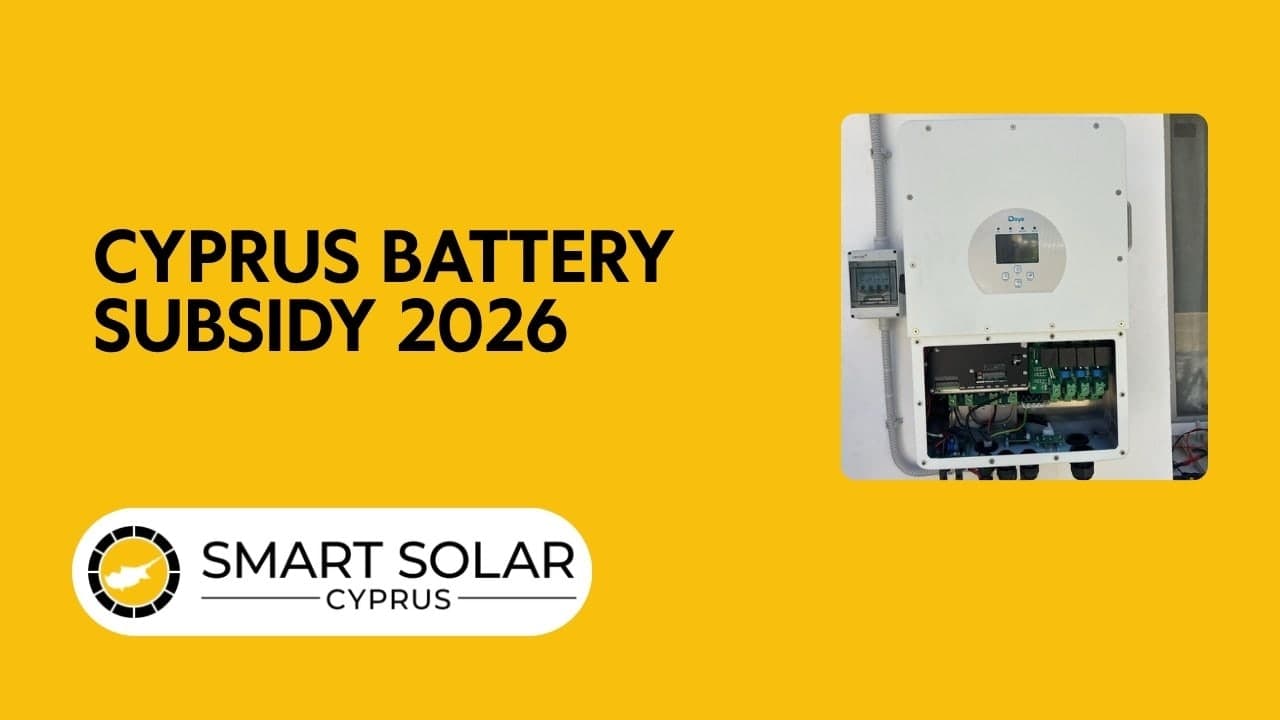
The most common question we have been asked this summer is not about panels. It is some version of: "Should I wait for the battery grant?"
It is a fair question. The government has been talking about a subsidy for home batteries since last autumn, every new solar system in Cyprus now connects under Net Billing, and a battery is the one piece of equipment that turns midday surplus into evening savings. If the state is about to pay for part of it, waiting a few months looks sensible.
The problem is that "about to" has now lasted almost a year. This post sets out exactly what has been said and by whom, what has actually opened, what a battery is worth with and without support, and what we would do in your position. Everything here is correct as of 1 September 2026, and we will update it when the picture changes.
Where the home battery subsidy stands right now
The short version: announced, repeated, still not open.
- October 2025. The Energy Ministry said a dedicated subsidy scheme for household batteries would launch by the end of the year, so that homes could store their own photovoltaic output for use in the evening. No budget or amounts were given.
- January 2026. Net Metering closed to new applications and Net Billing took over. The residential PV grant and the "Photovoltaics for All" scheme closed at the same time. From this point there was no open grant for a standalone home solar system.
- February 2026. The ministry told the press it was designing new support schemes in which installing a storage system, meaning a household battery, would be a mandatory condition for receiving a grant. The reasoning was explicit: the state no longer wants to subsidise systems that push their surplus onto the grid at midday.
- June to August 2026. The first contracts under the separate €35 million storage scheme for renewable-energy projects were signed, and Energy Minister Michalis Damianou announced that a grant scheme for energy storage in businesses would be published "in the immediate period". Nothing equivalent was published for households.
- 30 August 2026. The Cyprus Mail summarised the position bluntly: photovoltaic systems will apparently need storage to qualify for state support, yet no household subsidy scheme has been announced.
So as we write, there is no application window, no published budget, no grant amount per kilowatt-hour and no eligibility criteria for a standalone home battery. Anyone quoting you a confirmed figure is guessing. That includes installers.
Why the state wants batteries in homes
The pressure behind the scheme is real, and it explains why we still expect it to arrive.
Cyprus generates far more solar electricity at midday than the grid can absorb, and the grid operator switches generation off when it cannot. The Cyprus Mail, citing the grid operator's own data, reported that 162 gigawatt-hours were curtailed in the first five months of 2026. Every curtailed kilowatt-hour is sunshine that produced nothing for anyone.
The government's main answer is large batteries on the grid. The minister has said that 120 MW of grid-scale storage owned by the transmission operator is due to arrive in January 2027, that private developers have secured connection terms for more than 150 MW, and that he expects "several hundred megawatts" of storage in the system by the end of 2027. Those projects will ease curtailment for rooftop systems too, but not before next year.
Home batteries are the other half of the answer, and here the numbers are moving in the wrong direction for the ministry. The Cyprus Mail's figures show around 38,900 PV applications in 2025 against roughly 1,800 so far in 2026, after the rush to beat the Net Metering deadline. Battery applications did rise, from 89 in 2025 to 137 this year, but that is still a small fraction of systems. A subsidy is the obvious lever to change that, which is why we treat the scheme as delayed rather than abandoned.
What a battery is worth without any subsidy
Before deciding whether to wait, it helps to know what you are waiting to improve.
Under Net Billing, the electricity you export is credited at roughly €0.11 per kWh, while what you buy back in the evening costs around €0.25 to €0.30 per kWh all-in. Credits are netted against your bill each period and the account is cleared once a year in autumn, with any leftover surplus wiped. If your system is curtailed at midday, the exported energy is worth nothing at all. Our Net Billing guide covers the mechanics in detail.
A battery shifts that midday surplus into the evening, so every kilowatt-hour it stores is worth the difference between the export credit and the retail price, and the full retail price when the export would have been curtailed or wiped. For a family home with a 5 to 6 kW system and evening air-conditioning, the arithmetic looks roughly like this:
- Battery size: 10 kWh, which is the most common size we install on a three-bedroom house.
- Installed cost: €8,000 to €10,000 in 2026, in line with the €800 to €1,000 per kWh we see across brands.
- Energy shifted: 8 to 9 kWh on most days, close to 3,000 kWh a year given how many clear days Cyprus has.
- Value of that energy: between €0.14 and €0.30 per kWh depending on how much of your surplus would otherwise be exported, curtailed or wiped, so roughly €500 to €900 a year.
That puts an unsubsidised payback at somewhere around ten years, shorter for homes that see a lot of curtailment or heavy evening use, longer for a household that is out all evening. It is a sound long-term investment with a 10 to 15 year warranty behind it, but it is not the three-year payback that panels on their own deliver. That gap is precisely what a subsidy exists to close, and it is why the question of waiting is legitimate rather than lazy. The wider sizing and technology choices are covered in our battery storage guide.
The scheme that does open this month: Save and Upgrade Homes 2026
While the standalone battery grant is stuck, a different scheme that funds batteries is on the calendar. Save and Upgrade Homes 2026 (Εξοικονομώ – Αναβαθμίζω στις Κατοικίες) is a €20 million grant under the EU co-funded THALIA programme, and the ministry has said the call for applications will be announced within September.
The published terms so far:
- Eligible homes: houses and flats first connected to the electricity grid before 1 January 2008, with a domestic tariff account.
- Who can apply: private individuals, one application per person.
- The condition: the works must cut the home's primary energy use by at least 60%, verified by an energy performance certificate before and after. The initial certificate has to be issued before any work starts, and reports say it must date from after 15 May 2026.
- What it funds: insulation, window replacement, shading, solar water heating, heat pumps, photovoltaics under Net Billing, and battery storage systems.
- Ceilings reported in August: up to €32,000 for the larger investment category and up to €24,000 for the smaller one, with the exact percentages and per-measure caps to be set out in the implementation guide when the call opens.
Two things matter for battery buyers. First, the ministry has been clear that this is not a route to a standalone solar or battery grant: a home that only wants panels or only wants a battery cannot use it. Second, if you own a pre-2008 house that genuinely needs insulation and new windows anyway, bundling a Net Billing system and a battery into that package is currently the only way in Cyprus to get public money towards a home battery. Our grants guide sets this scheme alongside everything else that closed or opened this year.
The tax angle most people miss
The tax reform that came into force on 1 January 2026 added a green-transition deduction for individuals. Capital spending on energy upgrades to your main residence, and the published summaries list photovoltaics and electricity storage batteries by name, can be deducted from taxable income up to €1,000 per spouse or cohabiting partner, subject to income thresholds.
It is a modest sum next to a grant, but it applies now, it does not depend on a scheme opening, and it is worth raising with your accountant before you sign for a system this year.
Should you wait for the subsidy?
This depends on which of three situations you are in.
You are installing solar for the first time
Do not wait on the panels. The state has said in as many words that PV remains one of the best investments a household can make even under zero-export limits, provided the system is sized to your actual consumption, and our own numbers agree. Waiting a year for a battery grant would cost you a full year of savings on the panels themselves, which is far more than any plausible battery subsidy.
What you should do is make the system battery-ready. Specify a hybrid inverter from day one, so that a battery can be added later with a couple of hours' work and no replacement of the inverter. Our guide to choosing a solar inverter in Cyprus explains the difference, and it is the standard design in our full photovoltaic system packages.
You already have solar under Net Billing
This is where waiting has a real cost. Each month without a battery, you are buying back in the evening what you gave away at midday, typically €50 to €75 a month for the home in the example above. If the scheme opens within six months, that is a few hundred euros to wait for what could be a meaningful grant. If it slips by a year or two, as the business storage scheme did, the money lost in evening imports starts to rival anything the grant is likely to pay.
Our advice is to get a firm quote now, know your number, and set yourself a deadline. If the scheme has not opened by that date, install. One caution: Cyprus grant schemes have consistently funded only works carried out after approval or after a set start date, so a battery bought before the scheme opens is unlikely to qualify retroactively. If the grant matters to you, do not install early "just in case".
You are still on Net Metering
Your surplus is still credited one-for-one at retail value, so a battery has less to do for you than for a Net Billing customer, at least until the 36-month clearing of accumulated credits bites or your contract transitions. A battery is worth it mainly for backup during power cuts and for shifting the load you would otherwise buy at peak. Our post on whether you need a battery at all works through those cases.
How to be ready on day one
Cyprus grant schemes open with fixed budgets and close when the money is allocated. The last Net Metering window drew thousands of applications in its final weeks, and the RES Fund's schemes have routinely been oversubscribed. When the battery scheme opens, the households that get funded will be the ones whose files were ready before the announcement.
Keep the following to hand:
- Recent EAC bills, ideally a full year, so your consumption profile and tariff category are documented.
- Your grid connection details, including whether you are on Net Billing or Net Metering, the connection date of the property, and your existing PV system's size and inverter model.
- A written battery quotation with the usable capacity in kWh, the brand and model, and the safety certifications, since past schemes have required all of these on the application form.
- An energy performance certificate if you might use the Save and Upgrade route, because the works cannot start until it exists.
- An online government account, since recent schemes have been application-by-portal only.
We track every scheme as it moves, tell you plainly what you qualify for today and what is worth waiting for, and file the paperwork when a window opens. That is the whole point of our incentives and paperwork service, and our battery storage page sets out the systems we install once you decide to go ahead. If you would like the numbers for your own roof and bill, request a quote or start with the solar calculator.
Frequently Asked Questions
Is there a battery subsidy in Cyprus right now?
No. As of September 2026, a standalone home-battery subsidy has been announced by the Energy Ministry but no application window, budget, grant amount or eligibility criteria have been published. The only public money currently earmarked for home batteries is inside the Save and Upgrade Homes 2026 scheme, which funds batteries as part of a whole-home energy upgrade of pre-2008 properties.
Will a battery be compulsory for future solar grants in Cyprus?
That is what the ministry has signalled. In February 2026 it said new support schemes were being designed with storage as a mandatory condition, because it no longer wants to fund systems that export their surplus at midday. Until a scheme is published, treat this as stated intent rather than a rule.
Can I add a battery later to a solar system I install now?
Yes, provided the system is designed for it. A hybrid inverter lets you connect a battery later without replacing anything. A standard grid-tied inverter can also take a battery through a separate AC-coupled unit, but that costs more. If a subsidy is part of your plan, specify a hybrid inverter now and keep the battery purchase until the scheme opens.
Does Save and Upgrade Homes 2026 cover a solar battery?
Yes, battery storage is listed among the eligible measures, alongside Net Billing photovoltaics, insulation, windows, shading and heat pumps. The catch is that the home must have been connected to the grid before 2008 and the full package must cut primary energy use by at least 60%. A battery on its own does not qualify.
How much does a home battery cost in Cyprus in 2026?
Installed prices run at about €800 to €1,000 per kWh of usable capacity, so a 10 kWh lithium battery on an existing hybrid inverter costs roughly €8,000 to €10,000. Adding the hybrid inverter at the same time adds to that, which is why we recommend fitting one when the panels go in.
Want a quote tailored to your roof and your bill?
A free site visit and proposal, with no obligation and no pressure.
Keep reading
All articles
Virtual Net Billing in Cyprus: Solar Without a Roof
How virtual net billing in Cyprus works: panels on one site credit the EAC bill of another. Who it suits, the 400 kWp limit, real returns and the process.
How to Read Your EAC Bill With Solar Panels in Cyprus
Your EAC bill with solar panels, line by line: import and export readings, net metering credits, Net Billing euro credits, and why the bill can still rise.

Heat Pump With Solar Panels in Cyprus: 2026 Guide
Running a heat pump on solar in Cyprus: running costs, how much PV it needs in winter, what installation costs and how Net Billing changes the sums.