
Solar Panels for New Builds in Cyprus: Requirements, Planning & ROI
Solar planning for new builds in Cyprus: code requirements, roof design, cabling, system sizing, and ROI. What to specify before the foundations go in.
Updated July 2026 for the Net Billing rules and the battery-linked grant scheme now in force.
Building a new home in Cyprus is the one chance to get solar exactly right. Every compromise a retrofit has to make, awkward cable runs, a crowded roof, an inverter squeezed into a hallway, can be designed out before the foundations go in. And with new homes legally required to generate part of their own energy, the question is no longer whether to include photovoltaics but how well to integrate them.
This guide covers what the rules actually require, how Net Billing changes new-build system design, what to specify at each construction stage, and the realistic return on the investment.
What the rules require in 2026
Cyprus does not have a law that says "every new house must have PV panels". The obligations are set through energy performance requirements, and they get you to the same place:
- Energy class A is mandatory for new dwellings, demonstrated by an energy performance certificate.
- At least 25% of primary energy consumption must come from renewable sources (9% for hotels).
- The EU's revised buildings directive tightens this further: new buildings must be designed solar-ready, public buildings must be zero-emission from 2028, and all new buildings from 2030.
A rooftop photovoltaic system is the most practical and cheapest route to the 25% renewable share and the class A rating, which is why virtually every new detached home in Cyprus now includes a 3-7 kW array in its design. Architects treat it the way they treat insulation: not an optional extra, but part of passing certification.
Net Billing changed what a well-designed new build looks like
Every new system connects under Net Billing, the scheme that replaced net metering for all applications from 1 January 2026. Exported surplus earns roughly the wholesale rate of €0.08-0.10 per kWh; imported electricity costs the full retail rate of around €0.30. Energy you consume directly from your own roof keeps its full retail value. Our Net Billing explainer covers the scheme in detail.
For new-build design, three consequences follow:
- Self-consumption drives the layout. The system should be sized and oriented around when the household uses power, not around maximum theoretical export.
- A hybrid inverter is the default. It makes the system battery-ready from day one, and the 2026 state grants for new solar systems require storage to qualify.
- The technical room earns its keep. Inverter, battery space, ventilation and cable routes all want deciding on the architectural drawings, not on installation day.
Roof design: orientation, pitch and shade
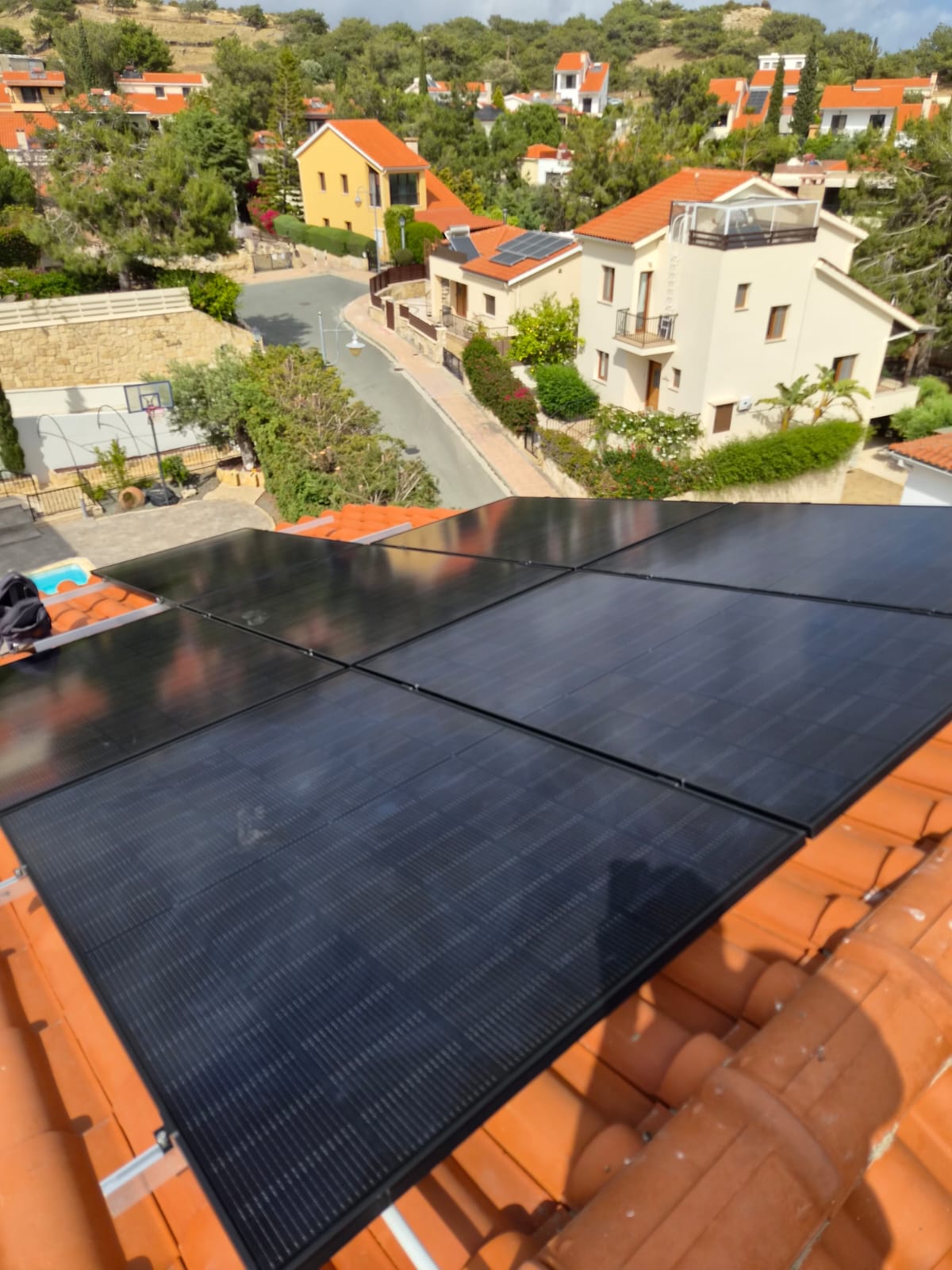
Orientation. A south-facing array maximises total annual yield, and on a generous roof it remains the first choice. But under Net Billing, an east-west split deserves serious consideration: it spreads production across morning and late afternoon, exactly when families are home and using power. Self-consumed energy is worth roughly three times exported energy, so matching the consumption profile can beat chasing peak output.
Pitch. Panels in Cyprus perform best tilted around 25-35 degrees. On pitched roofs the tiles set the angle; on the flat roofs common across the island, aluminium frames do, and they let the installer optimise both angle and orientation regardless of how the house sits on the plot.
Shade. The classic new-build mistake is finalising the roof plan, then discovering the water tank, chimney or parapet wall shades the best PV area every afternoon. Even partial shade can cut an array's output by 20-30%. Position tanks low or on a side platform, keep chimneys north of the array where possible, and check neighbouring plots for future construction.
Structure. A PV system adds only 10-15 kg per square metre. Any modern concrete roof in Cyprus carries this comfortably, but it belongs in the structural engineer's calculations, along with wind loading for the mounting points.
Electrical preparation during construction
This is where building solar-ready saves real money, and it costs almost nothing at construction stage:
- A dedicated conduit from roof to technical room. DC cabling reaches the inverter without surface trunking or chased walls. Specify a spare conduit too; it will be used eventually, whether for a battery, an EV charger or an extra string.
- An inverter position out of the sun. Technical room, garage or utility room. Inverters lose efficiency and lifespan in direct heat, so not the south wall.
- Ventilation for hybrid equipment. Inverters and batteries shed heat; a ventilated technical room keeps them at rated performance through a Cyprus summer.
- Reserved battery space. 1-1.5 square metres of floor, a clear cable route from the inverter, and ideally a fire-resistant wall backing. Cheap to allocate now, disruptive to improvise later.
- Three-phase supply, decided early. Larger systems, heat pumps and fast EV charging all favour three-phase; changing later is far more expensive than specifying it on the application.
Sizing the system to the household
Typical annual consumption for a modern Cyprus household runs 6,000-9,000 kWh, and the right system size follows from it:
- Couples and small homes: a 3 kW system producing around 5,000 kWh a year.
- Family homes: 4-5 kW, producing roughly 6,500-8,500 kWh.
- Large homes with a pool, underfloor heating or an EV: 5-7 kW, producing up to about 11,000 kWh, usually with battery storage sized to the evening load.
A 4 kW array needs around 18-20 m² of unshaded roof; scale up proportionally. Under Net Billing, resist the old habit of oversizing "because the grid pays for it": it no longer does. Surplus earns wholesale rates, so the best-performing systems are sized to real consumption, then extended with storage rather than extra panels. Our guide to production in Cyprus shows what each kilowatt actually yields through the year.
Panels and equipment for the Cyprus climate
Summer roof temperatures above 40°C, coastal humidity and Saharan dust are the operating environment, and equipment choice should reflect it: Tier-1 monocrystalline half-cell panels with strong temperature coefficients and 25-year performance warranties, and inverters from manufacturers with authorised support on the island. On bright flat roofs, a bifacial panel such as the Luxor 450W bifacial harvests reflected light from the roof surface for extra yield from the same footprint.
What a new-build system costs and returns
Because the roof is prepared and the cabling planned, installation on a new build is typically cleaner and slightly cheaper than a retrofit of the same size. Indicative 2026 turnkey prices: a 4 kW system runs €5,700-6,700 and produces around 6,500 kWh a year, worth roughly €1,950 annually at €0.30 per kWh when production is well matched to consumption. That puts payback at around three to three and a half years, and the panels carry on for 25-30 years.
Larger configurations follow the same maths: 5 kW at €6,500-7,500 saving about €2,550 a year; 7 kW at €9,200-10,200 saving about €3,300. The 2026 price guide has the full table, and the calculator turns your own consumption into a number.
Add a battery and the evening load moves onto stored sunshine as well. Installed battery prices run €800-1,000 per kWh of capacity, most homes need 10-14 kWh, and the 2026 grants only apply to systems that include one; details on our battery storage page.
The new-build solar checklist
At design stage
- Reserve the unshaded roof area and set orientation and pitch with the architect
- Decide single or three-phase, and system plus battery sizing from the planned lifestyle
- Add PV and spare conduits, technical room ventilation and battery space to the drawings
During construction
- Run DC/AC cable routes and roof penetrations before waterproofing
- Fit mounting reinforcements if the roof design needs them
- Confirm the meter and switchboard specification with the EAC application in mind
At completion
- Submit the Net Billing application (it can be prepared during construction)
- Install, commission, and configure monitoring
- Confirm any battery grant eligibility under the current call before ordering
We handle the paperwork end to end as part of a full photovoltaic system installation, from technical drawings to grid connection; the schemes and forms are covered on our Net Billing service page.
Frequently Asked Questions
Is solar mandatory for new builds in Cyprus?
There is no law that says a new house must have photovoltaic panels. What the rules do require is that every new home reaches energy class A and covers at least 25% of its primary energy consumption from renewable sources. In practice, a rooftop PV system is the simplest and cheapest way to meet that requirement, which is why nearly every new detached home in Cyprus now includes one by design.
What size solar system does a new build in Cyprus need?
Most new homes land between 3 kW and 7 kW. A modern Cyprus household uses roughly 6,000-9,000 kWh a year, and a 4 kW system produces around 6,500 kWh while a 5 kW system produces around 8,500 kWh. Homes with pools, underfloor heating or an EV should size towards 7 kW and plan battery capacity alongside.
Should a new build install the battery during construction or later?
At minimum, build battery-ready: specify a hybrid inverter, reserve 1-1.5 square metres in the technical room, and run the cable route. Installing the battery immediately has two advantages in 2026: the state grants for new solar systems require storage to qualify, and under Net Billing the battery starts capturing the gap between cheap exports and expensive evening imports from day one.
Do east-west roofs work for solar in Cyprus?
Yes, and under Net Billing they are sometimes preferable. A south-facing array maximises total annual output, but an east-west split spreads production across morning and late afternoon, which matches when households actually use power. Since self-consumed energy is worth roughly three times exported energy, matching your consumption profile can beat maximising raw yield.
Can the grid-connection paperwork start before the house is finished?
Yes. The Net Billing application can be prepared and submitted while the house is still under construction, so the system is approved and connected soon after the electricity meter is installed. We handle the EAC forms and technical drawings as part of the installation.
Next step: if you are at design stage, send us the plans. A free consultation with our engineers before the roof is finalised costs nothing and locks in options a retrofit can never recover.
Want a quote tailored to your roof and your bill?
A free site visit and proposal, with no obligation and no pressure.
Keep reading
All articles
How to Read Your EAC Bill With Solar Panels in Cyprus
Your EAC bill with solar panels, line by line: import and export readings, net metering credits, Net Billing euro credits, and why the bill can still rise.

Heat Pump With Solar Panels in Cyprus: 2026 Guide
Running a heat pump on solar in Cyprus: running costs, how much PV it needs in winter, what installation costs and how Net Billing changes the sums.
Solar Water Heating in Cyprus: Thermal vs PV in 2026
Your solar water heater's electric element versus heating water with surplus photovoltaic power. What each costs in Cyprus and which wins in 2026.